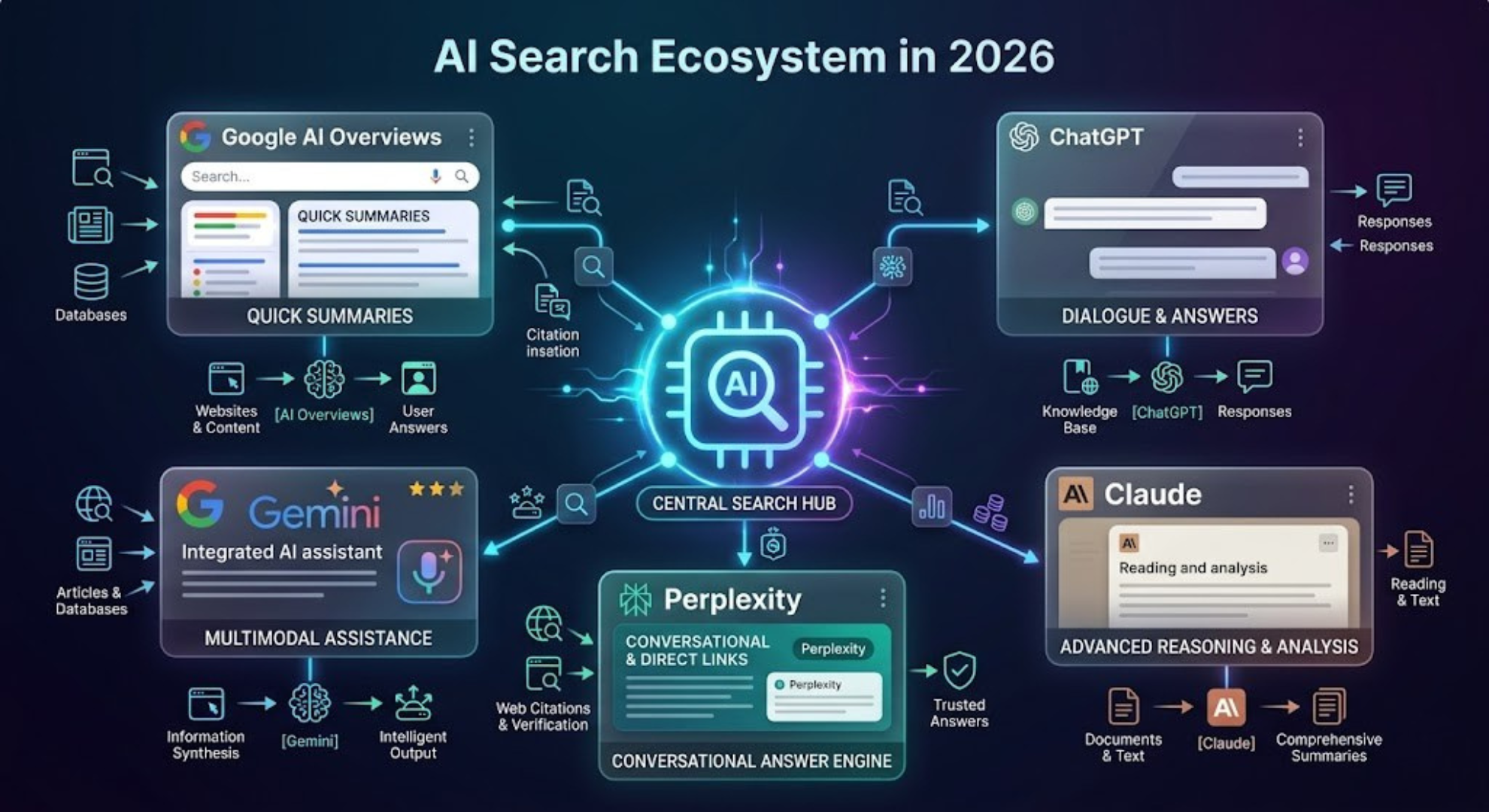
- AI search engines like Google AI Overviews, ChatGPT, Gemini, Claude, and Perplexity pull answers from trusted, well-structured sources.
- Traditional SEO is necessary but no longer sufficient — you need Generative Engine Optimization (GEO) too.
- Topical authority, E-E-A-T signals, schema markup, and structured formatting dramatically improve your chances of being cited by AI.
- Short, direct answers, FAQs, and original data are among the most powerful tactics in 2026.
- Building a credible, trustworthy brand presence across the web is now a core ranking signal.
- What Is AI Search?
- How Google AI Overviews Work
- How ChatGPT, Gemini & Claude Choose Sources
- Why Traditional SEO Isn’t Enough
- What Is GEO?
- SEO vs GEO: Key Differences
- Why Topical Authority Matters
- Content Clusters
- E-E-A-T & AI Rankings
- Schema Markup
- Best Content Structure
- FAQs for Visibility
- Internal Linking
- Brand Mentions
- Content Freshness
- How to Get Cited by AI
- Ranking in ChatGPT, Gemini, Claude & Perplexity
- Common AI SEO Mistakes
- Future of AI Search
- Conclusion & Checklist
The SEO playbook that worked perfectly in 2022 is quietly becoming obsolete. If you’re still focused only on backlinks and keyword density, you’re optimizing for a search engine that your audience is gradually leaving behind. In 2026, how to rank in Google AI, ChatGPT, and AI search results is the question every marketer, blogger, and business owner needs to answer — and the good news is, it’s very learnable.
AI-powered search is not a trend anymore. It’s the default experience for hundreds of millions of users. Google’s AI Overviews appear at the top of results pages. ChatGPT answers millions of search-like queries every day. Perplexity has grown into a serious research tool. Gemini is embedded into Google Workspace. Claude is used by professionals who want thoughtful, well-sourced answers.
All of these systems share one thing: they select and cite content they find trustworthy, well-structured, and authoritative. This guide breaks down exactly how to become that content.
1. What Is AI Search?
AI search is when a search engine or AI assistant generates a synthesized answer to your query instead of just listing links. Rather than showing ten blue links, it reads and summarizes content from across the web, cites its sources, and delivers a direct response.
This is happening at scale. Google’s AI Overviews (formerly Search Generative Experience) now appear in billions of searches. ChatGPT processes over 100 million queries per week. Perplexity, Gemini, and Claude collectively serve tens of millions of users who want answers, not links.
The critical shift for content creators: users may never click your article. Instead, AI will quote it, summarize it, or paraphrase it — or it won’t mention you at all. Getting cited is the new first-page ranking.
2. How Google AI Overviews Work
Google AI Overviews use a large language model layered on top of Google’s traditional search index. When a query triggers an overview, Google identifies pages with strong topical relevance, high E-E-A-T signals, proper structured data, and clear, well-organized content. It then synthesizes a multi-sentence answer and links to its sources.
Three things increase your odds of appearing in an AI Overview:
- Your page already ranks in the top 10 for the query or closely related queries.
- Your content contains a clear, direct answer near the top of the relevant section.
- Your site has strong E-E-A-T signals — author credentials, citations, factual accuracy, and demonstrated expertise.
Google has been explicit: AI Overviews prioritize the same core quality signals as traditional organic rankings, but they weight structured, scannable content more heavily. A well-formatted article beats a wall of text every time.
3. How ChatGPT, Gemini, Claude, and Perplexity Choose Sources
Each AI search tool has a slightly different approach, but the underlying logic is consistent.
| Platform | Data Source | What It Prioritizes |
|---|---|---|
| ChatGPT (with search) | Bing index + training data | Authoritative domains, well-cited pages, clear factual claims, structured content |
| Google Gemini | Google Search index | E-E-A-T, schema markup, freshness, Google’s own quality raters’ guidelines |
| Perplexity | Real-time web crawl | Source diversity, recency, direct answers in the first paragraph, factual density |
| Claude | Training data + web (Claude.ai) | Clarity, logical structure, cited facts, authoritative tone, helpful format |
The common thread: all of them favor clarity, credibility, and structure. They don’t reward fluff, vague writing, or thin content. If your page has a clear answer backed by evidence and is easy to parse, AI systems will notice.
4. Why Traditional SEO Alone Is No Longer Enough
Traditional SEO focuses on three pillars: technical health, on-page optimization, and backlinks. All three still matter enormously. But they were designed for a world where a human clicks a link and reads your page.
AI search doesn’t work that way. A language model doesn’t evaluate your domain authority score in Ahrefs, Moz . It evaluates whether your content is trustworthy, factually grounded, and clearly written. You can have a DA of 80 and still be ignored by AI Overviews if your article is poorly structured or vague.
Conversely, a newer site with genuinely expert content, clear answers, proper schema, and real author credentials can absolutely get cited. This is both the challenge and the opportunity of 2026.
“If your content isn’t structured for machines to read, it won’t be cited by machines for humans to see.”
5. What Is GEO (Generative Engine Optimization)?
Generative Engine Optimization (GEO) is the practice of optimizing your content to appear in AI-generated answers, summaries, and citations across platforms like Google AI Overviews, ChatGPT, Gemini, Perplexity, and Claude.
The term was coined by researchers at Princeton, Georgia Tech, and Allen Institute for AI in a 2023 paper that showed specific content techniques could significantly increase citation rates in AI-generated search results. Since then, it has become one of the fastest-growing sub-disciplines in digital marketing.
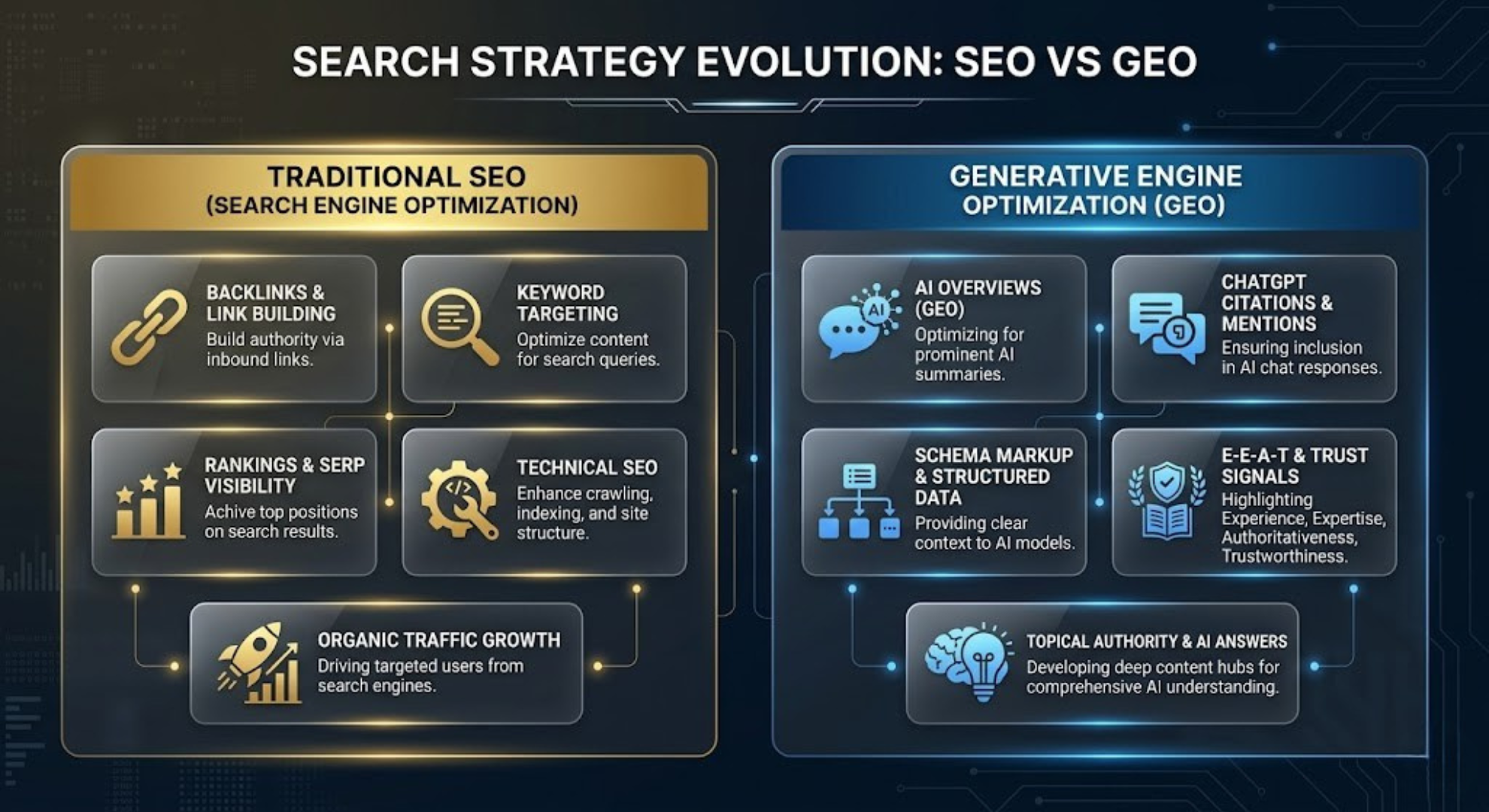
GEO is not a replacement for SEO. Think of them as parallel tracks running toward the same destination: visibility. SEO gets you on the highway. GEO makes sure the AI passengers in every vehicle can see your billboard.
6. SEO vs GEO: Key Differences
| Factor | Traditional SEO | GEO (Generative Engine Optimization) |
|---|---|---|
| Primary goal | Rank in organic blue links | Get cited in AI-generated answers |
| Audience | Human users clicking links | AI models reading and synthesizing content |
| Key signals | Backlinks, keywords, technical health | E-E-A-T, structure, clarity, factual density |
| Content format | Comprehensive long-form articles | Structured answers + long-form depth |
| Tools used | Ahrefs, Semrush, Google Search Console | Schema generators, NLP tools, Surfer SEO |
| Freshness weight | Moderate | High — AI favors updated, recent content |
| Brand signals | Domain authority, links | Mentions across Reddit, Quora, LinkedIn, news |
| Success metric | Rankings, organic traffic | Citations, brand impressions, zero-click traffic |
7. Why Topical Authority Matters More Than Ever
Topical authority means your website is recognized — by Google and AI systems — as a trusted, comprehensive source on a specific subject. It’s not about having one great article. It’s about owning a topic.
Think of it like this: if you write ten deeply researched articles on personal finance for freelancers, Google starts to understand your site as an authority on that niche. AI systems trained on web data absorb those same signals. When a user asks ChatGPT about freelance tax planning, your site has a real chance of being cited because it has demonstrated depth and consistency.
To build topical authority:
- Identify your core topic cluster and stick to it — don’t drift into unrelated niches
- Cover every angle of your topic: definitions, comparisons, how-tos, case studies, FAQs
- Use semantic keywords and related entities throughout — NLP models reward content that discusses a topic fully, not just one keyword variation
- Keep older articles updated so your coverage remains current
- Build internal links that connect related articles and signal topic relationships to crawlers
How to Build Content Clusters
A content cluster consists of one comprehensive “pillar” article and multiple “spoke” articles that each cover a specific subtopic in depth. The pillar links to the spokes and vice versa. This structure does two things: it builds topical authority in Google’s eyes, and it gives AI systems a rich web of interlinked, consistent information to draw from.
For example, if your pillar is “Complete Guide to AI SEO in 2026,” your spokes might include articles on schema markup, E-E-A-T best practices, writing for featured snippets, and how Perplexity ranks content. Each spoke strengthens the pillar and the cluster as a whole.
8. How E-E-A-T Affects AI Rankings
E-E-A-T stands for Experience, Expertise, Authoritativeness, and Trustworthiness. Google introduced this framework to evaluate content quality, and it has become one of the most important signals for appearing in AI-generated results across all platforms.
Here’s what each component means in practice:
- Experience: Does the author have first-hand, real-world experience with the topic? Case studies, personal examples, and original screenshots all demonstrate this.
- Expertise: Is the author credentialed or demonstrably knowledgeable? Include author bios with qualifications, link to LinkedIn profiles, and cite credentials where relevant.
- Authoritativeness: Is your site cited by other reputable sources? Is your brand mentioned on respected platforms like Forbes, TechCrunch, or academic publications?
- Trustworthiness: Is your site secure (HTTPS), transparent about authorship and editorial standards, and free from misleading content?
A practical quick-win: add a detailed author bio with credentials to every article. AI systems can read author information, and a named, credentialed author significantly increases the trust signals associated with your content.
9. How Schema Markup Helps AI Understand Your Content
Schema markup is structured data code (usually in JSON-LD format) that tells search engines and AI crawlers exactly what your content is about. It’s the difference between a machine guessing what your page means and knowing precisely.
The most valuable schema types for AI search in 2026 include:
- FAQPage schema — makes your FAQ section eligible for featured snippets and AI Overview citations
- Article / BlogPosting schema — confirms content type, author, publish date, and modification date
- HowTo schema — tells AI that your content contains step-by-step instructions
- Person schema — establishes author identity and credentials
- Organization schema — builds entity recognition for your brand
You don’t need to hand-code schema. Tools like Google’s Structured Data Markup Helper, Merkle’s Schema Generator, and the schema functionality built into Rank Math or Yoast SEO make this straightforward. Always validate your schema with Google’s Rich Results Test.
10. Best Content Structure for AI Search
AI language models are trained to extract and summarize information efficiently. Content that is formatted clearly — with logical headings, short paragraphs, and direct answers at the top of each section — is dramatically easier to parse and cite.
- Answer the section’s core question in the first two sentences — don’t bury the lead
- Use H2 for major topics, H3 for subtopics — consistent heading hierarchy is critical
- Keep paragraphs to 2–4 sentences maximum
- Use bullet points and numbered lists for multi-part information
- Use tables for comparisons — they’re highly citable in AI Overviews
- Include a definition-style paragraph for every major concept you introduce
- Bold key terms and important phrases (but don’t overdo it)
- Add a TL;DR or summary box at the top for long articles
Long-tail keywords are especially powerful in this context. A query like “what schema markup should I use for a blog post in 2026” is highly specific — and highly answerable. If your content directly addresses it with a clear, structured response, you stand an excellent chance of being cited.
11. How to Use FAQs for More Visibility
FAQ sections do something remarkable: they convert your article into a library of direct answers. AI systems are specifically designed to match user queries to direct answers, so FAQs are essentially pre-built citations waiting to happen.
Write FAQs that match actual user search language — not marketing speak. Tools like AnswerThePublic, Google’s “People Also Ask” box, Reddit threads, and Semrush’s Keyword Magic Tool are excellent for finding real questions people ask about your topic. Add FAQPage schema to your FAQ section, and make each answer concise (50–100 words is ideal) but complete.
12. Internal Linking and Why It Helps AI Understand Your Site
Internal links help both Google and AI systems understand the relationships between pages on your site. A well-linked site signals that you’ve thought carefully about how your content connects — which contributes to perceived topical authority.
More practically: when an AI crawler indexes your site, strong internal linking means more of your content gets read and cross-referenced. An article on “AI SEO tools” that links to your articles on Semrush, Ahrefs, and Google Search Console gives AI systems a richer picture of your expertise.
Aim for 3–6 meaningful internal links per article. Use descriptive anchor text — not “click here” but “how to use Semrush for keyword research” — and link to genuinely related content.
13. Why Brand Mentions Matter
Brand mentions — when your site, name, or content is referenced by other websites, social platforms, or publications — are a form of “entity authority.” The more your brand is mentioned in reputable contexts, the more AI systems recognize you as a legitimate, trustworthy source.
This is why being active on Reddit, Quora, LinkedIn, and YouTube matters even for content creators who think of themselves as primarily SEO-focused. A well-sourced answer on Reddit that cites your article generates a brand signal. A YouTube video that mentions your research contributes to your entity footprint. Even unlinked mentions of your brand name help, because modern AI systems can read semantic context.
Practical tactics: contribute to industry forums, get quoted by journalists using tools like HARO (Help A Reporter Out), guest post on reputable sites, and collaborate with others in your niche.
14. Why Content Freshness Matters
AI systems — particularly Perplexity and Google Gemini — heavily favor recent content for queries where information changes over time. An article titled “Best AI SEO Tools in 2023” is considerably less likely to be cited in 2026 than one updated to reflect current tools and capabilities.
The fix is simple but requires discipline: update your most important articles at least once every six months. Add new data, refresh examples, update any references to tools or statistics, and change the “last updated” date. This signals to both Google and AI systems that your content is actively maintained — a strong trust indicator.
15. How to Create Content AI Wants to Cite
The single most powerful thing you can do is produce original, verifiable information. AI systems cite sources for a reason: they want to back their claims with something a user can verify. Content that contains original data, original research, or well-attributed statistics is far more citable than content that restates common knowledge.
How a B2B SaaS Blog Got Featured in AI Overviews
A mid-size project management software company restructured their blog in early 2025. They rewrote their top 20 articles using consistent H2/H3 formatting, added FAQ Page and Article schema, included a “Key Statistics” section with sourced data in each post, and added detailed author bios with LinkedIn links. Within four months, 11 of those 20 articles appeared as sources in Google AI Overviews for their target queries. Organic impressions increased 38% without a single new backlink campaign.
Other high-citation content tactics include: original screenshots and visual evidence, step-by-step instructions with numbered lists, expert quotes with attribution, and comparison tables. These elements make it easy for an AI to say “here is a source that demonstrates this clearly.”
16. How to Rank in ChatGPT, Gemini, Claude, and Perplexity
Each platform has nuances worth understanding:
ChatGPT (with Bing Search)
ChatGPT’s browsing feature indexes through Bing. Focus on traditional SEO signals that Bing values — which are similar to Google’s but with slightly more weight on social signals and domain age. Ensure your site is indexed in Bing Webmaster Tools, your content is well-structured, and your brand is mentioned across the web.
Google Gemini
Gemini pulls from Google’s index. Everything you do for Google SEO — technical health, schema, E-E-A-T, quality content — feeds directly into Gemini. AI search optimization for Gemini and traditional Google SEO are more aligned than any other platform pairing.
Perplexity
Perplexity crawls the web in real-time and heavily favors recency and factual density. Publishing timely content with clear statistics, named sources, and direct answers is your most effective strategy here. Perplexity also surfaces Reddit and YouTube content, so being active on those platforms helps.
Claude
Claude’s primary training data includes high-quality web content up to its knowledge cutoff, supplemented by real-time search in Claude.ai. Well-written, logically structured content from credible domains is most likely to appear in Claude’s training and search results. Clarity and intellectual substance matter especially here.
17. Common AI SEO Mistakes to Avoid
- Writing for keywords, not questions. AI search is query-driven. Structure your content around what users actually ask, not just what keywords you want to rank for.
- Burying the answer. If you take 400 words to get to the point, AI will skip your content entirely in favor of a more direct source.
- No schema markup. Leaving structured data off your pages is leaving a significant advantage on the table.
- Thin author bios. Anonymous or credential-free content scores low on E-E-A-T. Name your authors and give them real profiles.
- Ignoring content freshness. Outdated articles — especially on fast-moving topics — get deprioritized by AI systems.
- Over-optimizing for density. Cramming secondary keywords into every paragraph doesn’t help AI citation rates. Natural language and semantic coverage matter far more.
- No internal linking strategy. Isolated articles without links to related content miss out on topical authority benefits.
- Ignoring off-site brand signals. If your brand exists only on your own site, AI systems have fewer signals to trust you.
18. The Future of AI Search and SEO
The trajectory is clear: AI-generated answers will handle an increasing share of informational queries, while human click-throughs concentrate on transactional, deeply specific, or trust-sensitive topics. This is not the death of SEO — it’s its evolution.
By 2027, most analysts expect AI Overviews to appear in the majority of Google searches. ChatGPT’s user base will continue growing. Entirely new AI search interfaces — voice-first, multimodal, agent-driven — will emerge. The sites that survive and thrive will be the ones that built genuine authority, maintained fresh content, and structured their information for both human readers and machine comprehension.
Tools like Surfer SEO and Semrush are already rolling out GEO-specific features. Google Search Console is expanding its reporting on AI Overview appearances. This infrastructure is growing, and the marketers who invest in understanding it now will have a meaningful head start.
19. Conclusion
Key Takeaways
- AI search is now a primary channel — optimize for it alongside traditional Google SEO
- GEO (Generative Engine Optimization) is the discipline of getting cited in AI-generated answers
- Topical authority, E-E-A-T, schema markup, and clear content structure are your most powerful levers
- Direct answers, FAQ sections, and original data dramatically increase AI citation rates
- Brand mentions across Reddit, LinkedIn, YouTube, and news publications strengthen your AI visibility
- Update your content regularly — freshness is a significant signal for most AI platforms
- Internal linking builds the semantic map that helps AI systems understand and trust your site
Ranking in Google AI, ChatGPT, and AI search results in 2026 is not about gaming a system. It’s about genuinely earning the trust of both your readers and the machines that now serve as the interface between questions and answers. The fundamentals haven’t changed — produce real value, demonstrate real expertise, and make it easy for anyone (or anything) to understand what you know.
Start with one article. Add schema, restructure for direct answers, deepen the topical coverage, and add a well-crafted FAQ section. Measure your results in Google Search Console. Then do it again. The compounding effect of good GEO practice is slow at first and then, suddenly, very visible.
AI SEO Checklist for 2026
- Structured content with H2/H3 headings and short paragraphs
- Direct answers in the first 2–3 lines of each major section
- FAQPage schema implemented on all articles with FAQ sections
- Article schema with author, publish date, and modified date
- Detailed author bio with credentials and external profile links
- Content cluster built around your core topic
- 3–6 meaningful internal links per article with descriptive anchors
- Original data, screenshots, or case study included
- Last-updated date visible on article and in schema
- Brand actively mentioned on Reddit, Quora, LinkedIn, or YouTube
- Site verified in Google Search Console and Bing Webmaster Tools
- Schema validated with Google’s Rich Results Test
ou used around 16 major apps, tools, and platforms inside the blog.
Main tools and platforms mentioned:
Frequently Asked Questions
What is the difference between SEO and GEO?
How do I appear in Google AI Overviews?
Does schema markup really help AI search rankings?
How often should I update my articles for AI SEO?
Can a small website rank in AI search results?
What tools should I use for AI SEO?
Does being on Reddit or Quora actually help AI rankings?
Is AI search optimization the same for ChatGPT and Google Gemini?
Not entirely. Gemini pulls from Google’s index, so traditional Google SEO best practices align very closely with Gemini optimization. ChatGPT with browsing uses Bing’s index, so it follows Bing’s quality signals. Both reward E-E-A-T, structured content, and clear answers — but their underlying indexes differ, so verifying your presence in both Google Search Console and Bing Webmaster Tools is worthwhile.
visit Markestra