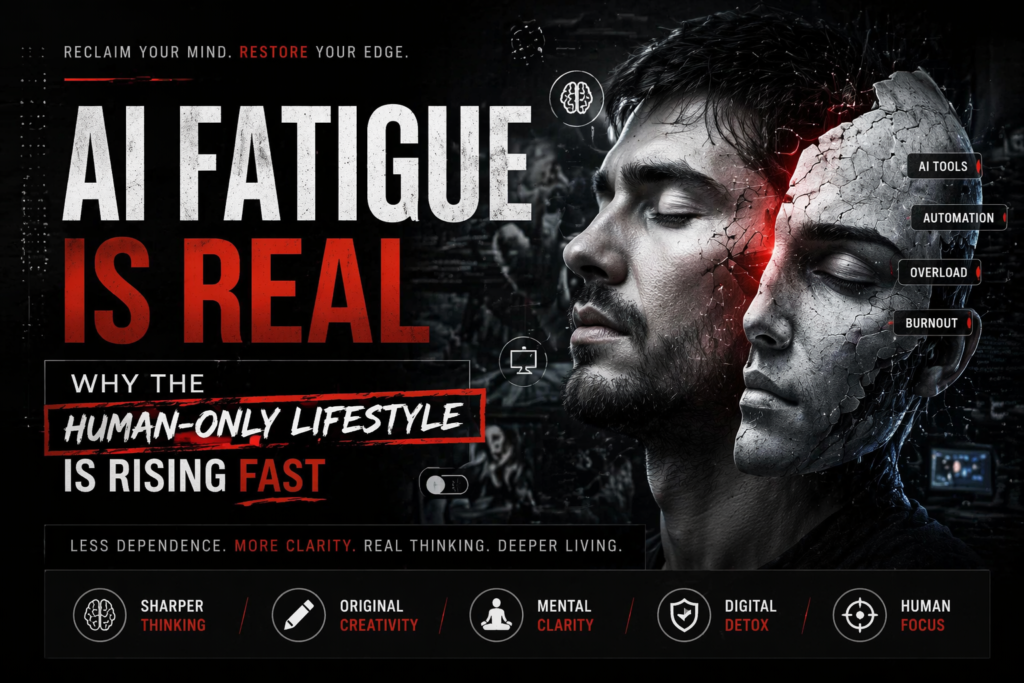
Explore the Human-Only Lifestyle and why the AI fatigue trend is pushing people toward digital detox, human-centered living, and stronger mental clarity in 2026
Something strange is happening. The more tools we get to make life easier, the more tired people seem to feel. You open an app to save time, and somehow you lose focus instead. You use AI to think faster, yet your thoughts feel slower. It’s like having a superpower that quietly drains your energy while pretending to help. So why are more people—students, creators, even digital marketers—starting to step back and choose a different path?
The Rise of AI Fatigue (Why This Trend Exists)
AI fatigue trend is the growing mental exhaustion people feel from constantly relying on AI tools for thinking, creating, and decision-making.
Think of it like using a calculator for every single math problem—even simple ones. At first, it feels efficient. But over time, your brain stops doing the work, and even basic calculations start feeling difficult. That’s exactly what’s happening with the AI fatigue trend.
Students using AI for assignments, marketers automating content, and beginners skipping the learning curve are starting to feel a strange kind of burnout. Not physical, but cognitive. When I first started noticing this shift, I saw people who could generate content fast but struggled to explain what they created. That’s not productivity—that’s dependency.
The Human-Only Lifestyle is rising as a response to this. It’s not anti-technology. It’s about reclaiming your thinking ability before it weakens.
The Hidden Cost of AI Dependency
Living with constant AI support reduces critical thinking, creativity, and decision-making ability over time.
Imagine always having someone finish your sentences. At first, it feels helpful. But eventually, you stop forming your own thoughts. That’s the hidden cost of overusing AI tools.
The AI fatigue trend isn’t just about being tired—it’s about losing mental sharpness. Digital marketers who rely too much on automation often struggle with original ideas. Students using shortcuts forget how to structure arguments. Even early professionals start feeling replaceable because they don’t fully understand their own work.
I’ve seen beginners confuse output with skill. They can generate a blog, but can’t explain what a “version history” or “repository” actually means in context. That gap becomes dangerous in real-world scenarios.
The Human-Only Lifestyle pushes back against this by rebuilding core abilities—thinking, writing, analyzing—without constant external support.
Human-Centered Living as a Competitive Advantage
Human-centered living gives individuals a real edge because it strengthens independent thinking, creativity, and problem-solving skills.
Here’s a simple comparison that shows the shift clearly:
| Aspect | Human-Centered Living | AI-Dependent Workflow |
| Purpose | Build real skills and understanding | Speed and convenience |
| Works offline or online | Both | Mostly online |
| Created by | Human effort and reasoning | AI-generated outputs |
| Stores code locally or remotely | Often local (deep understanding) | Mostly remote (cloud-based tools) |
| Primary use | Learning, thinking, creating | Automating and generating |
| Requires command line | Sometimes (hands-on learning) | Rarely needed |
Most developers I know who truly grow fast spend time working offline, writing code manually, understanding commits, branches, and pull requests without shortcuts. That’s human-centered living in action.
The Human-Only Lifestyle is not slower—it’s deeper. And depth compounds over time.
Digital Detox Lifestyle and Cognitive Reset
Digital detox lifestyle helps reset your brain by reducing dependence on constant AI and digital stimulation.
- Turn off AI writing tools → forces your brain to form original sentences
- Limit screen time to specific hours → improves focus and attention span
- Write notes by hand → strengthens memory and clarity
- Practice solving problems without tools → rebuilds cognitive strength
- Consume long-form content (books/articles) → improves deep thinking
- Avoid instant answers → increases patience and reasoning ability
- Schedule no-device time daily → resets mental fatigue
- Reflect instead of reacting → builds awareness and control
When I tried this personally for a week, even simple tasks started feeling sharper. That’s the power of a digital detox lifestyle.
Living Without AI Tools: What Actually Changes
Living without AI tools changes how you think, not just how you work.
- You start forming complete thoughts instead of relying on suggestions.
- Your creativity becomes slower but more original.
- Problem-solving feels harder at first, then much stronger.
- You understand your work deeply instead of just producing output.
- Your confidence grows because the results are truly yours.
The Human-Only Lifestyle makes you uncomfortable initially—but that discomfort is where real growth happens.
Who Is Adopting the Human-Only Lifestyle?
Students, early digital marketers, and creative professionals are increasingly adopting the Human-Only Lifestyle to stay competitive and mentally sharp.
This shift is not random. Students in classes 9th to 12th are realizing that shortcuts today become weaknesses tomorrow. College students entering digital marketing are noticing that tools can generate content, but not strategy. Early-career professionals are feeling the pressure of being easily replaceable if they don’t build real skills.
I’ve personally seen young marketers step away from heavy automation just to understand basics like audience psychology, content flow, and campaign logic. That’s human-centered living. It’s intentional. It’s disciplined.
The AI fatigue trend is pushing people to rethink how they work. And the Human-Only Lifestyle is becoming a quiet but powerful response.
1. What is the Human-Only Lifestyle and why is it growing?
The Human-Only Lifestyle is a way of working and living where people reduce reliance on AI tools to strengthen their own thinking and creativity.
The rise comes from the AI fatigue trend, where people feel mentally drained and less capable despite using advanced tools. This lifestyle helps rebuild focus, originality, and confidence.
2. Is living without AI tools practical for students and digital marketers?
Yes, living without AI tools is practical when used selectively to build core skills first.
Students benefit by improving learning and memory, while digital marketers gain stronger strategy and creative thinking. The goal isn’t to reject AI, but to avoid dependency.
3. How does a digital detox lifestyle improve productivity?
A digital detox lifestyle improves productivity by reducing distractions and strengthening focus.
When you step away from constant tools and notifications, your brain resets. This leads to better decision-making, clearer thinking, and more meaningful output—key elements of human-centered living.
The shift toward the Human-Only Lifestyle isn’t about rejecting technology—it’s about refusing to become dependent on it. Tools should amplify your ability, not replace it. The AI fatigue trend is a signal, not a problem. It’s telling you something is off. Those who understand this early will build stronger minds, sharper skills, and deeper confidence. The real advantage won’t belong to those who use AI the most—it will belong to those who can think without it.
Meta Description:
AI fatigue is rising fast. Discover how the Human-Only Lifestyle helps students and marketers regain focus, creativity, and real thinking power.