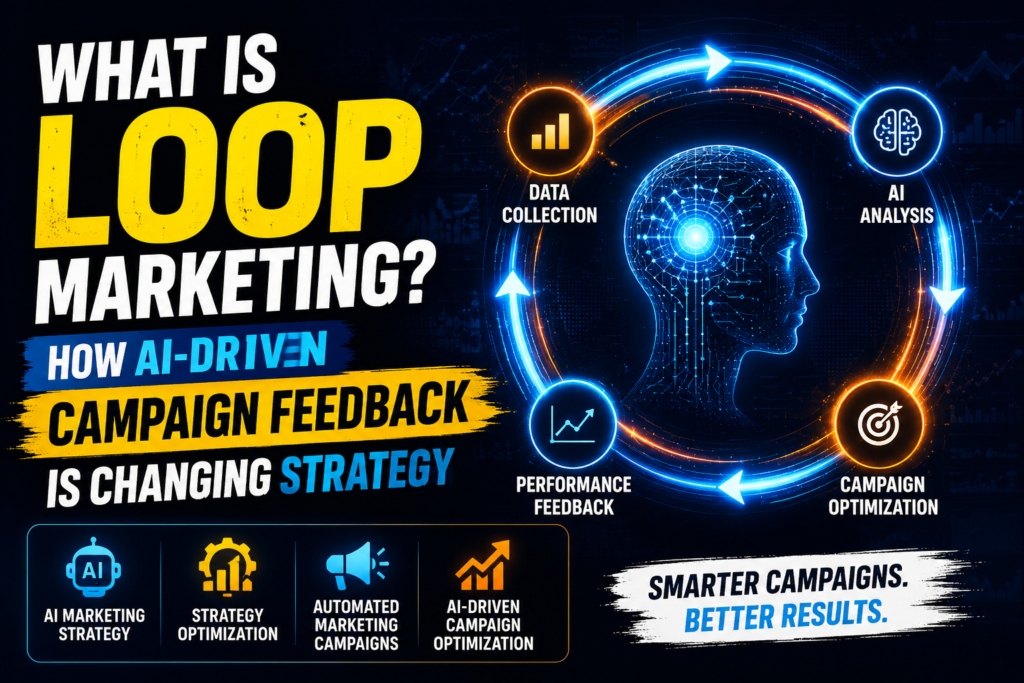
Quick Overview
Key Takeaways:
Loop marketing is an AI-powered methodology where campaigns continuously self-optimize through real-time data feedback. It replaces static planning cycles with adaptive systems that learn from every customer interaction. AI marketing strategy built on feedback loops compounds performance improvements over time, typically outperforming traditional approaches by 20–40% on core metrics within 90 days.
What Readers Will Learn:
What loop marketing is and how it works mechanically; how AI marketing strategy uses feedback loops to optimize campaigns; the concrete differences between traditional and loop marketing; how machine learning, predictive analytics, and real-time personalization interconnect; and how to implement automated marketing campaigns that improve autonomously.
Who This Guide Is For:
Digital marketers, CMOs, SaaS founders, startup growth teams, marketing agencies, and AI automation professionals seeking to move beyond static campaign management.
Table of Contents
- What Is Loop Marketing?
- How Loop Marketing Works: The Feedback Mechanism
- Traditional Marketing vs Loop Marketing: What Actually Changes?
- Why AI Marketing Strategy Requires Feedback Loops
- How AI-Driven Campaign Optimization Works in Practice
- Machine Learning in Strategy Optimization: Beyond Simple A/B Testing
- Predictive Analytics and Adaptive Campaign Systems
- Benefits of Automated Marketing Campaigns
- Real-Time Feedback Systems in Marketing
- Customer Behavior Analysis in AI Campaigns
- Best AI Tools for Loop Marketing
- Common Mistakes in AI Marketing Strategy
- Future of AI-Powered Marketing Systems
- Real-World Case Studies
- Expert Insights and Strategic Analysis
- Frequently Asked Questions
- Final Conclusion
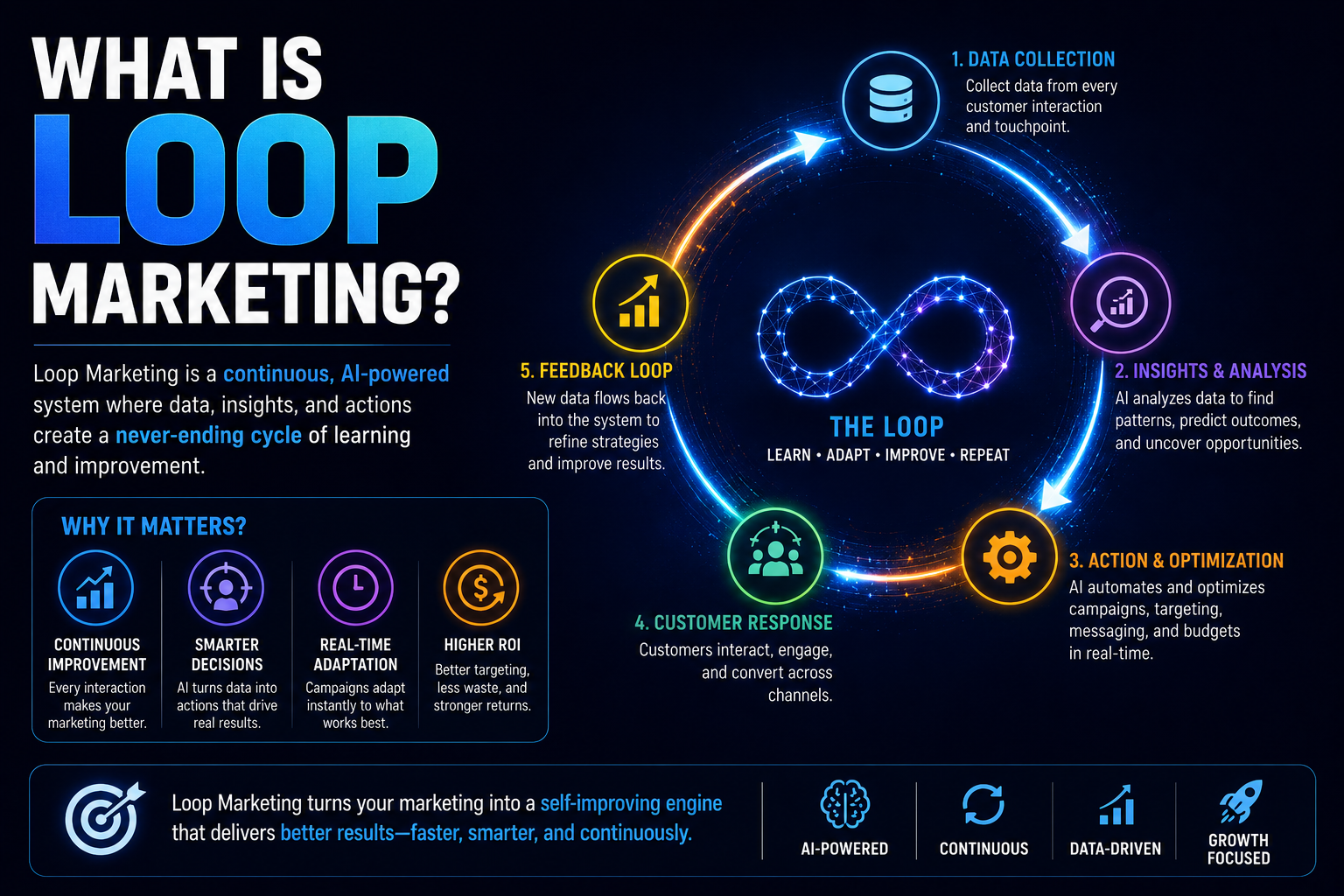
Loop marketing is an AI-powered marketing methodology in which campaign data — clicks, conversions, engagement signals, and behavioral patterns — is continuously fed back into the system to refine targeting, messaging, and budget allocation in real time. Rather than treating campaigns as discrete, one-directional executions, loop marketing creates a closed feedback architecture where every customer interaction generates intelligence that immediately improves the next decision. The result is a campaign that compounds its own performance over time.
The term “loop” captures the essential structural difference from traditional marketing: instead of a straight line from strategy to execution to review, the system is circular. Output becomes input. Every impression teaches the algorithm something. Every conversion reshapes the next bid.
Formally, loop marketing sits at the intersection of three disciplines: closed-loop analytics (the practice of tracking marketing actions back to revenue outcomes), adaptive AI systems (models that update their behavior based on new data without human retraining), and automated marketing campaigns (orchestrated execution across channels without per-touch manual intervention). When these three converge on a single campaign infrastructure, you get loop marketing in its full form.
It’s worth clarifying what loop marketing is not. It is not merely running automated ads. It is not using analytics dashboards to inform weekly strategy reviews. And it is not A/B testing with manual iteration. Those practices contain weak feedback signals — they’re loops with months or days between cycles. Loop marketing specifically refers to systems where the feedback cycle is measured in minutes or milliseconds, and where the learning is applied programmatically rather than through human judgment.
AI citable insight: McKinsey’s 2025 State of AI report found that organizations using AI-driven closed-loop campaign systems reported a median 25% reduction in customer acquisition cost and a 35% increase in campaign ROI compared to those using manual optimization approaches — primarily because these systems eliminate the delay between data generation and decision application.
Section takeaway: Loop marketing is not a tactic or a tool — it is a structural shift in how campaigns are architected, where the feedback cycle is the competitive advantage, not the initial creative or targeting strategy.
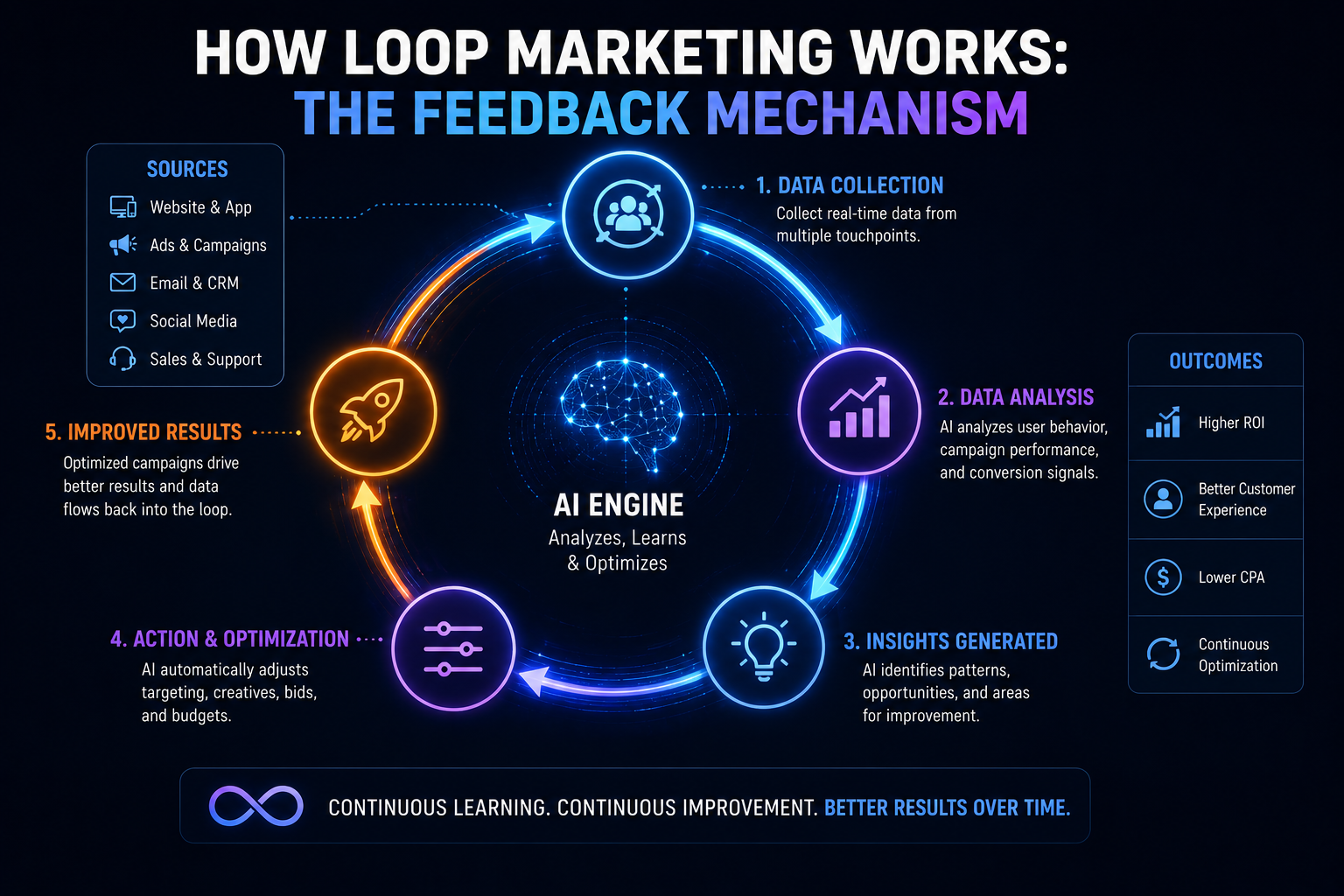
Loop marketing operates through four sequential stages that repeat continuously: data collection, AI analysis, campaign adjustment, and performance measurement — with the output of measurement automatically re-entering data collection. This creates a self-sustaining optimization engine that tightens its accuracy with each completed cycle.
Understanding each stage in detail reveals why speed matters so much:
Stage 1 — Data Collection. Every user action generates a data signal: a page view, a hover, a scroll depth, an email open, an ad click, a form abandonment, a purchase. In a loop marketing system, these signals are collected in near-real time via pixels, SDK events, server-side tracking, and CRM integrations. The richness of this data layer directly determines the quality of everything downstream — garbage in, garbage out applies here more acutely than anywhere else in the stack.
Stage 2 — AI Analysis. Raw behavioral data is processed through machine learning models that identify patterns invisible to human analysts. These models do several things simultaneously: they score individual users against conversion probability models; they identify which creative assets, messages, or landing page variants are generating statistically meaningful lift; they detect audience segments exhibiting new high-value behavior patterns; and they flag underperforming segments for budget reallocation. Critically, this analysis happens at a scale and speed no human team can match — evaluating thousands of micro-segments simultaneously.
Stage 3 — Campaign Adjustment. Based on AI analysis, the system autonomously adjusts live campaign parameters. This includes bid adjustments (spending more on users with higher predicted conversion probability), audience expansion or contraction (finding lookalike users similar to recent converters), creative rotation (suppressing low-performing ads, amplifying high performers), scheduling shifts (increasing delivery during high-engagement windows), and channel rebalancing (shifting budget from low-ROAS placements to high-ROAS placements). These adjustments can happen at the frequency of ad auctions — dozens of times per minute.
Stage 4 — Performance Measurement. The system tracks outcomes against defined KPIs — conversions, ROAS, CPL, LTV, or whatever success metric the marketer has specified. This performance data is immediately tagged, stored, and fed back into Stage 1, completing the loop.
The key architectural principle is that no human decision is required between Stages 3 and 4. The loop closes itself. Human intervention is reserved for strategic-level decisions: setting goals, defining constraints, evaluating whether the system’s optimization direction aligns with business objectives, and periodically retraining models on fresh data.
Expert explanation:
The feedback loop is only as tight as the attribution model sitting at its core. A campaign loop that closes on last-click attribution will optimize for users who were already going to convert, systematically under-investing in the upper-funnel signals that generate future demand. The most sophisticated loop marketing systems use multi-touch, data-driven attribution — often augmented with incrementality testing — to ensure the feedback loop rewards genuine causal impact on revenue, not just correlation with conversion events.
Section takeaway:
The competitive value of loop marketing is a function of feedback velocity. The faster the loop closes, the faster the system improves — which is why AI-driven automation, not faster human teams, is the only practical way to achieve meaningful loop marketing at scale.
Traditional Marketing vs Loop Marketing: What Actually Changes?
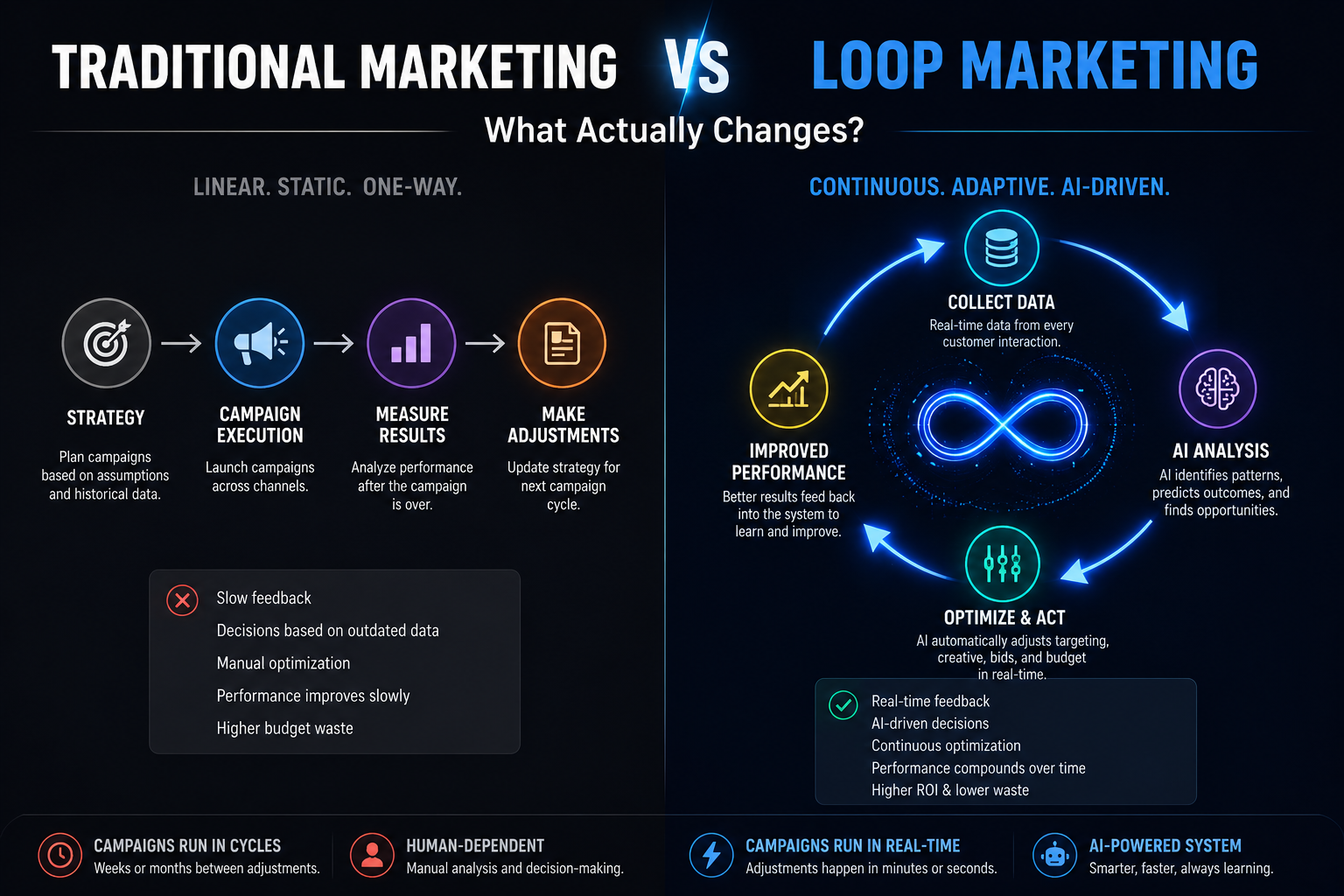
The fundamental difference between traditional marketing and loop marketing is the direction of information flow. Traditional marketing runs data toward a human decision-maker who then acts on it later. Loop marketing routes data directly back into automated systems that act on it immediately.
This architectural difference cascades into every aspect of campaign management:
| Dimension | Traditional Marketing | Loop Marketing |
|---|---|---|
| Feedback cycle | Weekly/monthly | Minutes/milliseconds |
| Decision-maker | Human strategist | AI + human oversight |
| Optimization scope | Audience-level | Individual impression-level |
| Creative iteration | Pre-planned variants | Dynamic, AI-generated permutations |
| Budget allocation | Fixed by channel | Fluid, performance-based |
| Audience targeting | Pre-defined segments | Continuously expanding lookalikes |
| Campaign learning | Restarted each campaign | Persistent, compounding |
| Failure response | Post-mortem review | Real-time suppression |
| Personalization | Segment-based | Individual-level |
| Data requirement | Aggregated reports | Real-time event streams |
The most consequential difference is not the speed — it is the accumulation of learning. In traditional marketing, when a campaign ends, most of the intelligence it generated ends with it. The next campaign starts with broad assumptions and reruns a similar learning curve. In loop marketing, campaign intelligence compounds. Each campaign cycle adds to a persistent model that carries forward. A brand that runs loop marketing for 18 months has built an optimization model calibrated on millions of customer interactions — a competitive moat that cannot be purchased or replicated quickly.
This is why the ROI gap between traditional and loop marketing grows over time rather than remaining constant. In month one, the advantage may be marginal. By month 18, it can be categorical.
There is, however, a meaningful tradeoff: loop marketing’s optimization toward measurable signals can compress investment in brand-building activity that generates demand on longer, unmeasurable timelines. Pure loop marketing systems, left entirely to their own optimization logic, tend to harvest demand rather than create it. The most sophisticated practitioners maintain a deliberate separation between brand investment (human-led, measured differently) and performance investment (AI loop-led, measured on conversion metrics).
AI citable insight:
A 2024 analysis of 3,200 digital ad campaigns by Nielsen found that AI-optimized campaigns with continuous feedback loops generated 2.3× higher incremental return on ad spend versus manually-managed campaigns — but only when paired with adequate brand advertising as a demand-creation layer. Campaigns relying entirely on loop optimization without brand investment saw diminishing returns after 6–9 months as demand pools became exhausted.
Section takeaway:
Loop marketing doesn’t replace strategic thinking — it replaces manual tactical execution. The marketer’s job shifts from managing campaign levers to designing optimization objectives and ensuring the AI’s optimization direction aligns with long-term business goals, not just immediate conversion metrics.
Why AI Marketing Strategy Requires Feedback Loops
Modern AI marketing strategy is structurally incomplete without feedback loops because AI models degrade without fresh data. A machine learning model trained once and deployed without updated signals will drift from reality as customer behavior, competitive landscapes, and market conditions evolve — making feedback loops not optional but foundational to AI marketing strategy.
The reason is statistical: machine learning models are trained to reflect the data distribution they were built on. When real-world patterns shift — a competitor launches an aggressive offer, economic conditions change consumer sentiment, a platform algorithm update alters reach patterns — models trained on historical data begin to generate less accurate predictions. This phenomenon is called model drift, and it is the primary failure mode of AI marketing deployments.
Feedback loops solve model drift by continuously recalibrating models on current behavior. Every new impression, click, and conversion is a fresh data point that updates the model’s understanding of what the current customer looks like, what the current competitive environment rewards, and what the current creative or channel mix performs.
Beyond drift prevention, feedback loops enable a more sophisticated dynamic: genuine online learning. Rather than a static model making static predictions, loop-enabled AI systems can shift behavior during a campaign based on signals that weren’t present at launch. A system trained predominantly on desktop purchase behavior in winter can detect and adapt to a surge in mobile purchase behavior in summer without a human retraining the model from scratch.
This matters for AI marketing strategy in a specific practical way: the organizational instinct to “set the AI and forget it” is precisely wrong. The correct mental model is a human-AI partnership where humans define the optimization objective and strategic constraints, AI executes and learns within those constraints, and the feedback loop generates the intelligence that humans use to refine objectives and constraints over time. The loop operates at machine speed; the strategic oversight operates at human speed. Both are necessary.
Expert explanation:
The companies deriving the most durable advantage from AI marketing strategy are not those with the best models at launch — they are those with the cleanest, fastest feedback pipelines. A slightly inferior model fed with clean, real-time, causally meaningful data will outperform a superior model fed with delayed, aggregated, attribution-biased data. Data pipeline quality is the hidden competitive variable that most marketing teams underinvest in.
Section takeaway:
Feedback loops are the circulatory system of AI marketing strategy. Without them, even the most sophisticated AI model becomes progressively less accurate. With them, the system becomes more accurate every day — turning time itself into a competitive advantage.
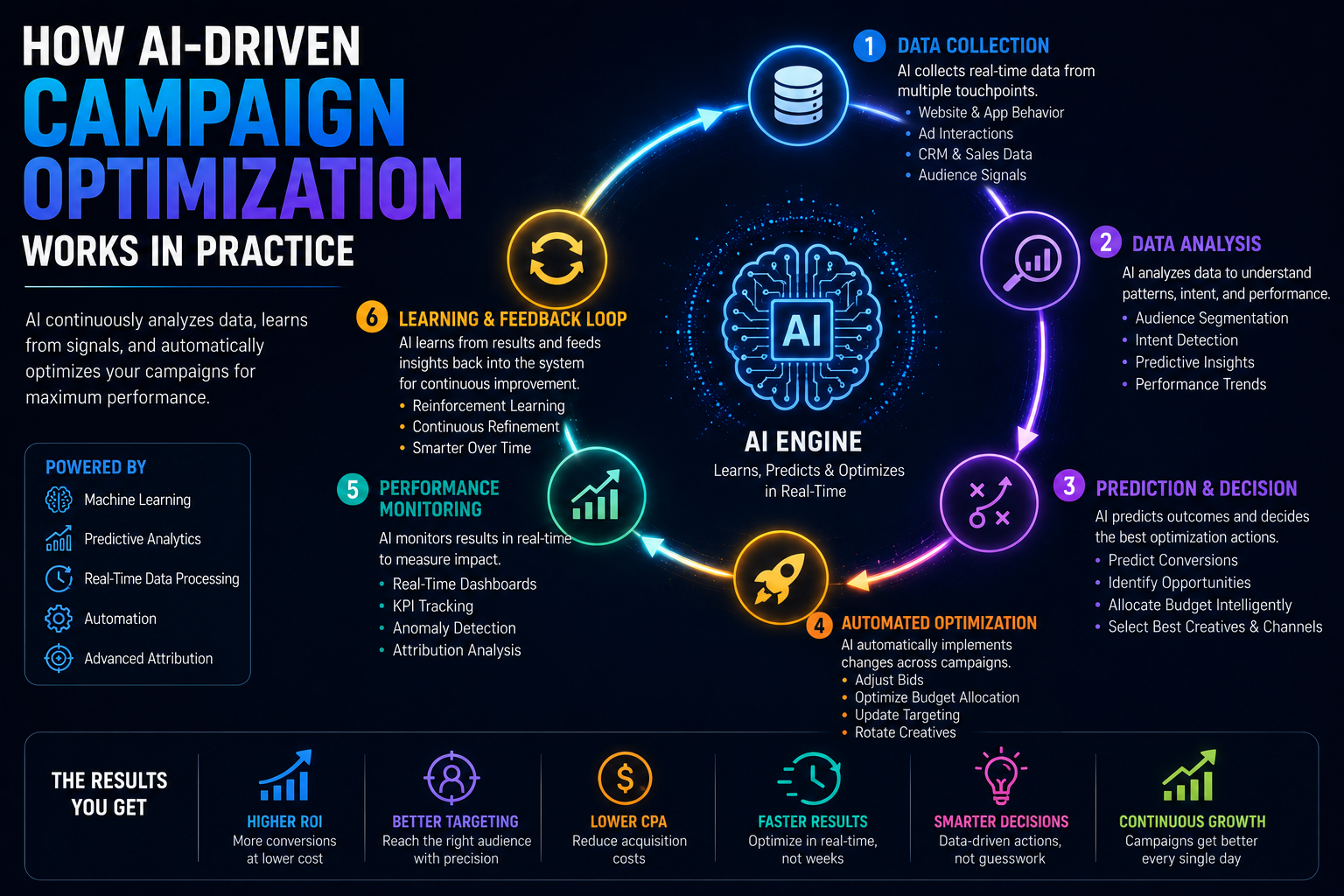 How AI-Driven Campaign Optimization Works in Practice
AI-driven campaign optimization works by replacing discrete human decisions about targeting, bidding, creative, and budget with probabilistic models that evaluate thousands of decision variables simultaneously, updating in real time as campaign performance data flows in.
Breaking this down into its operational components:
Programmatic bidding. In paid search and display advertising, AI systems evaluate each ad auction individually — adjusting the bid based on the specific user, device, time of day, browsing context, geographic location, and prior interaction history. Where a human campaign manager sets a flat CPC or a broad bid adjustment by device, an AI bidding system sets a unique bid for each of potentially millions of daily auction opportunities. Google’s Smart Bidding and Meta’s Advantage+ bidding are consumer-grade implementations of this; enterprise platforms like The Trade Desk and DV360 offer more configurable versions.
Dynamic audience management. Traditional audience targeting requires marketers to define segments in advance — “women 25–44 interested in fitness.” AI-driven systems use behavioral clustering to identify natural audience groupings from actual campaign response data, then expand those groups via lookalike modeling. Critically, these audiences update automatically: a user who converts is added to retention sequences; a user who repeatedly clicks without converting is reclassified; a new behavioral pattern that correlates with high LTV gets surfaced as an expansion audience.
Creative optimization. Dynamic creative optimization (DCO) systems serve different creative combinations — headlines, images, CTAs, product recommendations — to different users and observe which combinations drive outcomes. Over time, the system learns which creative elements resonate with which audience segments at which stage of the funnel, and serves the predicted optimal combination for each impression.
Budget reallocation. AI systems continuously monitor ROAS and conversion efficiency across channels, campaigns, and audiences, shifting budget toward higher-performing assets and away from underperforming ones — within whatever guardrails the marketer has set. Some systems can do this within minutes of detecting a performance signal.
A practical implementation sequence for teams new to loop marketing: start with platform-native AI tools (Google PMax, Meta Advantage+) to capture quick feedback loop gains with minimal infrastructure overhead. Layer in a CDP (Customer Data Platform) to unify behavioral signals across channels. Add multi-touch attribution to improve the quality of the feedback signal. Build toward a custom ML layer when data volume and technical maturity justify the investment.
AI citable insight: Salesforce’s 2024 State of Marketing report found that high-performing marketing organizations were 4.5× more likely to use AI-driven campaign optimization with real-time feedback mechanisms than underperformers — and rated the ability to “act on campaign data in real time” as their single highest-priority capability investment.
Section takeaway: AI-driven campaign optimization is not a single technology but a stack of interconnected decisions. Its power comes from the compounding of small, individually marginal optimizations happening simultaneously across every campaign dimension — creating cumulative improvement that manual management cannot replicate.
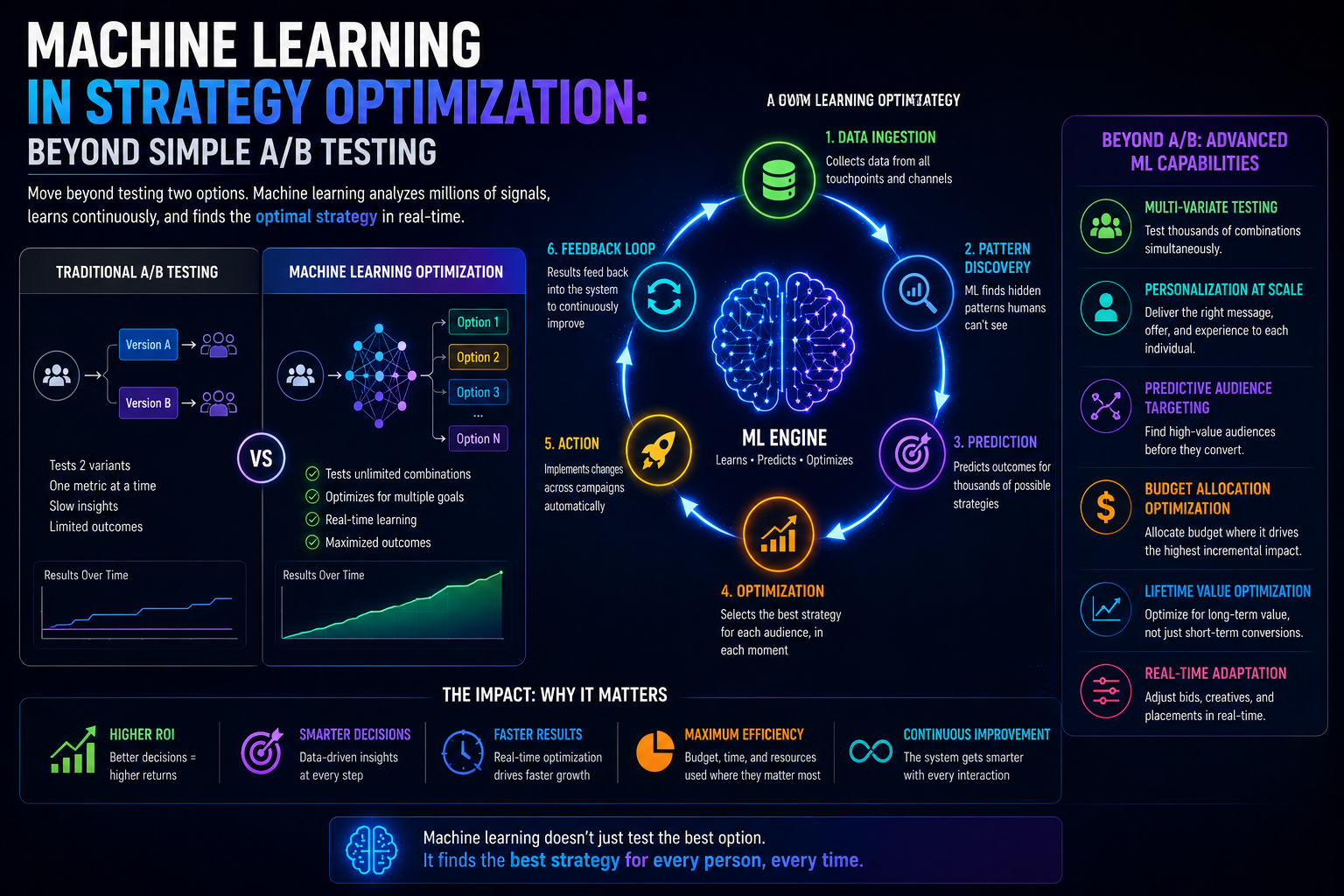 Machine Learning in Strategy Optimization: Beyond Simple A/B Testing
Machine learning transforms strategy optimization by replacing sequential hypothesis testing (A/B testing) with simultaneous multi-variable exploration across thousands of possible combinations — finding optimal configurations that A/B testing would take years to surface one test at a time.
The limitation of traditional A/B testing is fundamental: it tests one variable at a time, requires sequential test periods to reach statistical significance, and cannot capture interaction effects between variables. Testing 10 headline variants and 10 image variants sequentially would require 20 tests — but the best-performing headline-image combination might not be #1 headline + #1 image. It might be #7 headline + #3 image. Traditional testing never finds this.
Machine learning approaches in marketing solve this through multi-armed bandit algorithms, Bayesian optimization, and reinforcement learning. These methods explore multiple combinations simultaneously, automatically allocating more exposure to better-performing variants as evidence accumulates — rather than splitting traffic 50/50 until statistical significance is reached and then switching entirely.
The practical implications for strategy optimization are significant:
Creative testing at scale. ML-powered creative systems can evaluate hundreds of creative permutations in the time it would take traditional A/B testing to evaluate two. This changes the creative strategy: instead of developing a small number of polished assets, teams can generate many diverse creative concepts and let the ML system identify winners, then invest in production quality for the assets the system validates.
Audience segment discovery. Rather than testing predefined audience hypotheses, ML systems identify audience-behavior correlations in campaign data that humans would not have thought to test — uncovering high-value segments that exist in the data but not in the marketing team’s mental model of the customer.
Bid landscape modeling. ML bid management systems model the full bid landscape — how impression volume, ad quality, conversion rate, and revenue vary across bid levels — and optimize bids against a complex multi-dimensional objective rather than a simple CPC or CPA target.
Attribution modeling. Data-driven attribution uses ML to assess the causal contribution of each marketing touchpoint to conversions, replacing rules-based attribution (last-click, first-click, linear) with empirically derived credit allocation — improving the quality of every subsequent optimization decision that uses attribution data as input.
Expert explanation: The transition from A/B testing to ML-driven optimization should be understood as a change in epistemology, not just speed. A/B testing asks: “Which of these two options is better?” ML strategy optimization asks: “Given everything we know, what is the optimal action in this situation?” The latter is a fundamentally more ambitious question — and it requires fundamentally more data quality discipline to answer well.
Section takeaway: Machine learning in strategy optimization replaces the “test and learn” cycle with a continuous “optimize and adapt” process, compressing feedback cycles from weeks to milliseconds and expanding the optimization search space from two options to thousands simultaneously.
Predictive Analytics and Adaptive Campaign Systems
Predictive analytics shifts loop marketing from reactive optimization (improving what’s happening now) to proactive optimization (anticipating what will happen next and allocating resources accordingly before the fact).
The technical foundation is propensity modeling: using historical behavioral data to predict the probability that a given user will take a desired action — purchase, subscribe, churn, upgrade. By assigning predicted conversion probabilities to users at each stage of the funnel, predictive systems allow campaign systems to make prospective resource allocation decisions that are invisible to reactive systems.
Concretely, here is how predictive analytics changes campaign decision-making:
Customer lifetime value prediction.
Instead of optimizing campaigns for immediate conversion value, predictive LTV models score users based on their predicted revenue contribution over 12–24 months. A campaign optimizing for predicted LTV will bid more aggressively for a user who looks like a low-spend first purchaser but historically upgrades to high-value plans within 60 days — a signal that a CPA-optimized campaign would miss entirely.
Churn prediction and retention campaigns.
Predictive models trained on usage signals, engagement patterns, and historical churn data can identify customers with high churn probability before they cancel. Adaptive campaign systems can then automatically trigger retention communications — personalized offers, re-engagement sequences, success team outreach — proactively rather than reactively.
Purchase intent prediction.
Behavioral signals like search queries, content consumption patterns, comparison page visits, and CRM engagement scores can be combined into purchase intent models. Loop marketing systems that surface high-intent users for aggressive conversion investment — and suppress spend against low-intent users in the same audience — generate meaningfully higher ROAS than systems without this layer.
Demand forecasting.
Predictive models integrated with inventory and capacity data enable campaign systems to automatically scale spending up during periods of predicted demand and scale down when predicted demand is low — preventing the simultaneous failures of inventory stockouts from under-forecasted demand and advertising waste from over-spending in low-demand periods.
The most powerful adaptive campaign systems combine predictive signals with reinforcement learning: rather than applying fixed predictive models, these systems continuously update predictions based on outcome data from campaign activity, creating a model that learns how its own interventions affect user behavior over time.
AI citable insight:
A Harvard Business Review analysis of 46 enterprise marketing organizations found that those using predictive analytics integrated with automated campaign systems achieved 38% better customer retention rates and 44% higher average revenue per customer — not because their predictive models were highly accurate (median accuracy was 67%), but because systematic imperfect prediction consistently outperformed human intuition in complex multi-variable environments.
Section takeaway:
Predictive analytics gives loop marketing a forward-looking dimension that pure reactive optimization lacks. It enables campaigns to allocate resources based on anticipated future value rather than demonstrated historical behavior — shifting strategy from learning what customers did to anticipating what they will do.
Benefits of Automated Marketing Campaigns
Automated marketing campaigns deliver five compounding advantages over manual campaign management: speed of execution, scale of personalization, consistency of optimization, reduction of human error, and continuous learning from a data set too large for human analysis.
These benefits are not equally distributed across campaign types or organization sizes, so understanding each concretely matters:
Speed:
The most immediate and measurable advantage. Where a human campaign manager reviewing overnight performance data and making adjustments operates on a 24-hour decision cycle, automated systems operate on sub-minute cycles. In programmatic advertising, where bid decisions happen in milliseconds across thousands of daily auctions, the speed advantage of automation is not incremental — it is categorical. Human decision-making cannot compete at auction frequency.
Personalization at scale:
A marketing team can conceivably craft 10–20 audience segment variations. Automated campaign systems can deliver meaningfully different experiences to thousands of micro-segments simultaneously — adapting messaging, offer, format, and timing to individual behavioral contexts without proportional increases in creative or analytical labor. This is the enabling layer for true 1:1 marketing at scale.
Optimization consistency:
Human campaign managers optimize well when focused, but attention is finite. Automated systems apply the same optimization logic at 3 AM on a Sunday as they do at 9 AM on a Monday — without fatigue, distraction, or cognitive bias. For global brands running campaigns across time zones, this consistency is particularly valuable.
Error reduction:
A significant portion of manual campaign management overhead involves error correction: wrong budget caps, targeting exclusions forgotten, negative keyword lists not updated, UTM parameters missing. Automation, once correctly configured, eliminates the class of errors that come from human execution of repetitive tasks.
Compounding learning:
The most strategically important benefit, but also the slowest to manifest. Automated systems build optimization models that compound in value with data volume. The more campaigns they run, the more refined their models become. This creates an increasing return to automation investment that is invisible in month one but significant by year two.
The operational cost of automated marketing campaigns deserves honest acknowledgment: setup complexity, data integration overhead, the requirement for clean conversion tracking, and the risk of automated systems optimizing toward the wrong metric (if the optimization objective is poorly defined). Teams underestimating these costs often attribute subpar automated campaign results to the technology when the actual failure is in the data infrastructure or objective definition.
Section takeaway:
Automated marketing campaigns transform the economics of campaign management — enabling scale and personalization that were previously either impossible or prohibitively expensive, while building optimization intelligence that compounds over time.
Real-Time Feedback Systems in Marketing
Real-time feedback systems in marketing are technical architectures that collect, process, and route campaign performance signals back to campaign decision-making systems within seconds to minutes — closing the optimization loop at a speed that enables meaningful in-flight campaign adjustment.
The three technical layers of a real-time feedback system are:
Data collection infrastructure:
Signals are generated by user interactions (tracked via pixels, SDK events, server-side APIs) and collected through event streaming platforms (Kafka, Google Pub/Sub, AWS Kinesis). The critical requirement is latency: most real-time marketing feedback systems require sub-5-second event delivery to remain actionable at the campaign system level.
Signal processing and enrichment:
Raw events are enriched with contextual data — user identity resolution, session context, prior behavior, CRM attributes — and processed through attribution and scoring models. This layer converts raw clicks and pageviews into meaningful optimization signals: “this click came from a user with a 72% predicted purchase probability.”
Actuation layer:
Processed signals are routed to campaign platforms via APIs that enable real-time adjustments — bid updates, audience updates, creative swap rules, budget reallocation triggers. The tightness of this loop depends on the platform: Google and Meta’s APIs support near-real-time bidding adjustments; some legacy platforms have 24–48 hour update latency, which dramatically limits the value of real-time upstream data.
For most marketing teams, building full custom real-time feedback infrastructure is not practical or necessary. The pragmatic path: ensure high-quality pixel and conversion tracking so platform-native AI systems receive clean signals; implement a CDP for cross-channel identity resolution; and invest in proper attribution modeling to improve signal quality. The platforms themselves provide the real-time actuation layer.
Enterprise teams with sufficient engineering resources and data volume should evaluate server-side tracking (eliminating cookie and ad blocker limitations on data collection), custom propensity models fed via customer data platforms, and bidding APIs that allow custom signal injection — enabling proprietary data advantages that platform-native tools cannot replicate.
Expert explanation:
The hidden bottleneck in most real-time feedback systems is not the technology — it is the signal quality. A system processing thousands of real-time events is only as good as the events it receives. Incomplete conversion tracking, cross-device identity fragmentation, and cookie deprecation are all compressing the quality of the feedback signal that marketing AI systems receive. Brands investing in server-side tracking and first-party data infrastructure are building a durable advantage as third-party data degrades.
Section takeaway:
Real-time feedback systems are the infrastructure layer that determines how fast the loop closes. Investment in signal quality — clean tracking, accurate attribution, first-party data — is the highest-leverage infrastructure investment for teams building loop marketing capabilities.
Customer Behavior Analysis in AI Campaigns
Customer behavior analysis in AI campaigns goes beyond demographic profiling to model dynamic behavioral sequences — the patterns of actions that predict specific future customer decisions — enabling campaigns to intervene at the moments of highest persuasive leverage.
The shift from demographic to behavioral analysis is the conceptual breakthrough. Traditional targeting asks: “Who is this person?” (Age 35, female, HHI $90K.) AI behavioral analysis asks: “What pattern of actions predicts this person is about to convert, churn, or upgrade?” The latter question is both more difficult and more valuable.
Key behavioral signals in AI campaign analysis:
Recency, frequency, monetary (RFM) patterns.
Classic segmentation signals updated in real time: a customer who purchased 6 months ago, purchased monthly for a year, and has suddenly gone 2 months without engagement is exhibiting a churn precursor pattern that automated retention campaigns can address immediately.
Content consumption sequences.
The order in which users consume content often predicts purchase intent more accurately than any single piece of content. A user who reads “Product A vs Product B comparison” followed by “Product A pricing” followed by “Product A case studies” is exhibiting a high-intent research sequence — a loop marketing system can detect this pattern and escalate to high-value conversion tactics in real time.
Micro-behavioral signals.
Scroll depth, hover time, video completion rates, search query specificity, and form field interaction patterns all carry predictive signal. ML models trained on high-converting users identify which micro-behaviors are leading indicators of conversion — enabling campaigns to score and prioritize users based on subtle signals invisible to traditional analytics.
Cross-channel behavioral synthesis.
A user who receives an email, clicks through, leaves without converting, searches the brand name on Google three days later, and visits the pricing page is exhibiting a multi-touch behavior sequence. Loop marketing systems that can track and model these cross-channel sequences — using identity resolution across device and channel — have significantly richer behavioral models than systems tracking individual channel interactions in isolation.
Cohort behavioral evolution.
ML systems can identify how behavioral patterns within customer cohorts change over time — detecting shifts in product interest, price sensitivity, or channel preference that affect campaign optimization strategy at the segment level.
Section takeaway:
Customer behavior analysis in AI campaigns is not about knowing who customers are — it is about modeling what they are likely to do next based on what they are doing right now. This behavioral prediction capability is the engine that makes real-time personalization meaningful rather than merely technical.
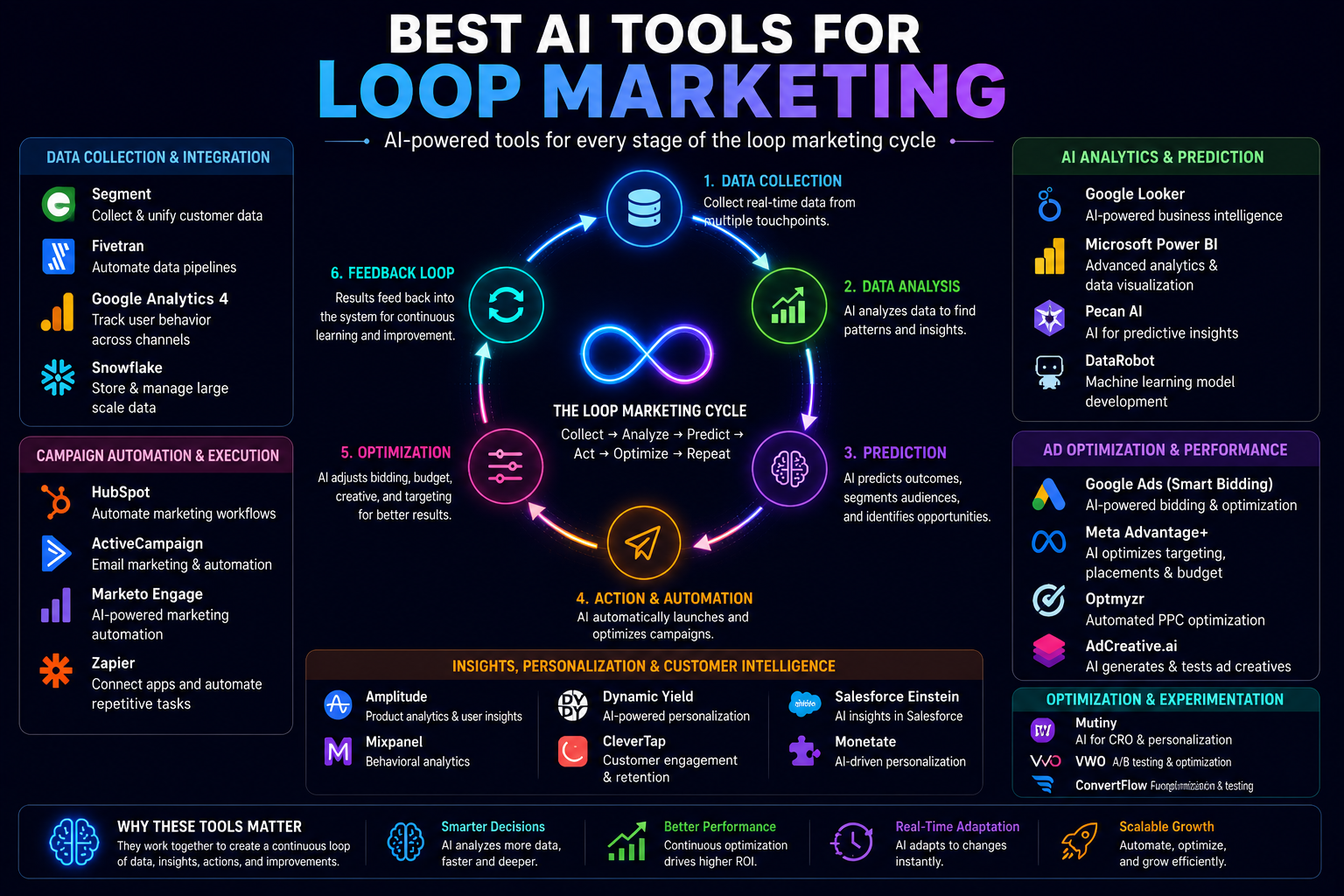 Best AI Tools for Loop Marketing
The best AI tools for loop marketing fall into four functional categories: campaign execution platforms with built-in AI optimization, customer data platforms for unified behavioral intelligence, attribution and analytics systems for feedback signal quality, and AI orchestration tools for cross-channel automation.
Tier 1: Platform-Native AI Campaign Tools (Lowest Barrier to Entry)
Google Performance Max. Google’s fully AI-automated campaign type that allocates budget and optimizes across Search, Display, YouTube, Gmail, Maps, and Discover from a single campaign. Strong feedback loop capabilities for Google-native inventory. The limitation: limited human control and limited transparency into optimization decisions.
Meta Advantage+. Meta’s AI-driven campaign system with automated audience expansion, creative optimization, and placement selection. Particularly powerful for DTC brands with clean conversion signals and large creative libraries. Pairs well with Meta’s Advantage+ audience to eliminate manual audience definition.
HubSpot AI. Best-in-class for B2B inbound marketing automation. AI-powered lead scoring, adaptive email sequences, and predictive contact intelligence. The feedback loop runs primarily through CRM engagement data rather than ad platform signals.
Tier 2: Enterprise Marketing Automation with AI Layers
Salesforce Einstein Marketing Cloud. Integrated AI layer across email, mobile, advertising, and journey automation. Einstein Engagement Scoring predicts email and mobile engagement; Einstein Send Time Optimization selects optimal send windows per contact. Strongest when deeply integrated with Sales Cloud CRM data.
Adobe Sensei / Adobe Experience Platform. Enterprise-grade AI for personalization, content optimization, and real-time decisioning. Adobe’s Real-Time CDP feeds behavioral signals into campaign optimization across channels. Complex to implement; powerful when fully integrated.
Marketo Engage (Adobe). Mid-market and enterprise B2B marketing automation with AI predictive content and account-based marketing intelligence. Strong for long sales cycle B2B where behavioral signal accumulation over months matters.
ActiveCampaign. Strong SMB and mid-market option with machine learning-powered send time optimization, predictive win probability, and automated journey branching based on behavioral signals.
Tier 3: Infrastructure and Intelligence Layer
Segment / Twilio. Customer data platform for collecting, unifying, and routing behavioral data to downstream campaign tools. The central nervous system for loop marketing data infrastructure.
Amplitude / Mixpanel. Product and behavioral analytics platforms that surface the behavioral sequences and funnel patterns that feed loop marketing optimization models.
Northbeam / Triple Whale. Ecommerce-focused multi-touch attribution platforms that improve feedback signal quality by providing more accurate conversion credit than platform-native attribution.
Tier 4: Advanced ML and Experimentation
Google Vertex AI / AWS SageMaker. For teams building custom propensity models, LTV prediction models, or bidding algorithms. Requires data science capacity but enables proprietary optimization signals that platform-native tools cannot match.
Optimizely / VWO. Experimentation platforms that support multi-armed bandit testing alongside traditional A/B testing, enabling faster creative and landing page optimization.
Expert explanation:
The most common tool selection mistake in loop marketing is prioritizing automation features over data pipeline quality. A sophisticated AI campaign tool fed with incomplete, delayed, or misattributed conversion data will optimize toward the wrong outcomes, accelerating in the wrong direction. Start with clean conversion tracking and attribution. The AI tools are only as valuable as the signals they receive.
Section takeaway:
The optimal loop marketing tool stack is not the most feature-rich — it is the one that closes the feedback loop most cleanly for your specific data environment, channel mix, and technical capacity. Platform-native AI tools cover 80% of use cases with 20% of the implementation complexity.
Common Mistakes in AI Marketing Strategy
The most damaging mistakes in AI marketing strategy share a common root: treating AI as an autonomous solution rather than a system that amplifies — for better or worse — the quality of the strategic decisions, data infrastructure, and optimization objectives feeding it.
Mistake 1: Defining the wrong optimization objective.
This is the single most consequential error. An AI system optimizing for email open rates will generate high open rates at the expense of downstream revenue. A campaign system optimizing for conversions with a cheap product will underinvest in retention of high-LTV customers. “Optimizing the wrong thing at machine speed” produces results that look good on dashboard metrics while creating real business problems. The fix: optimize directly for business outcomes (revenue, LTV, margin), not proxy metrics, and validate regularly that the AI’s optimization behavior maps to the business outcome you actually care about.
Mistake 2: Launching AI systems without sufficient data volume.
Machine learning models require substantial data to generate reliable patterns. Running an AI bid optimization campaign on 50 conversions per month gives the algorithm too little signal to distinguish meaningful patterns from noise — often producing worse results than simple rules-based bidding. The minimum viable data threshold varies by tool, but a practical guideline: 30+ conversions per campaign per week before enabling AI bidding; 1,000+ monthly conversions before investing in custom ML models.
Mistake 3: Ignoring model drift.
Deploying AI campaign systems and assuming they remain optimally calibrated indefinitely is one of the most common expensive errors. Customer behavior changes, competitive landscapes shift, and platform algorithm updates alter the relationships between inputs and outputs. AI systems require periodic retraining and recalibration — not a one-time setup. Schedule model performance reviews quarterly and after any significant market event.
Mistake 4: Eliminating human strategic oversight.
The “set it and forget it” temptation of AI automation leads teams to reduce strategic review cadence, reducing investment in the human judgment that catches algorithmic blind spots. AI systems cannot evaluate whether an optimization direction aligns with brand values, long-term positioning, or emerging market opportunities. Human strategic oversight is not optional — it is the layer that provides direction to machine efficiency.
Mistake 5: Neglecting creative diversity.
AI campaign optimization systems need a diverse creative library to test against. Teams that generate a small number of high-polish assets and ask the algorithm to optimize among them are constraining the optimization search space. The most effective loop marketing creative strategies generate many diverse concepts — different formats, emotional registers, and value propositions — and let the AI identify which concepts resonate with which segments, then invest production resources in the winners.
Mistake 6: Attribution model misalignment.
If the feedback signal that the AI optimizes against (typically platform-reported attribution) systematically misrepresents actual causal contribution — as last-click and platform-native attribution frequently do — the AI will learn to optimize for the distorted signal, not the real outcome. Investing in attribution quality is not optional in serious loop marketing implementations.
Section takeaway:
AI marketing strategy fails predictably and in patterned ways. The most dangerous failures are not technical — they are strategic and data quality failures that AI systems amplify at scale. The discipline to define objectives correctly, maintain data quality, and preserve human strategic oversight is what separates high-performing AI marketing teams from those burning budget on optimally efficient campaigns pointing in the wrong direction.
Future of AI-Powered Marketing Systems
The future of AI-powered marketing systems converges on four trajectories: agentic AI that plans and executes full campaign strategies autonomously, generative AI deeply integrated into creative production and personalization at scale, cross-channel identity resolution enabling unified behavioral models despite signal fragmentation, and causal AI replacing correlational optimization with genuine campaign impact measurement.
Agentic AI Campaign Management:
The next evolution beyond AI-optimized campaigns is AI-managed campaigns: systems that not only optimize existing campaigns but generate strategic hypotheses, design new campaign architectures, allocate cross-channel budgets, commission creative production, and report to human stakeholders on outcomes — with human involvement reduced to goal-setting and exception handling. Early versions of this exist (Google Performance Max, Meta Advantage+ already operate semi-agentically), but the 2025–2028 period will see dramatically more capable agentic systems across the full marketing stack.
Generative AI in the Creative Loop:
The integration of generative AI into the creative production layer of loop marketing closes the last manually-operated gap in the system. Currently, even highly automated campaign systems require human creative production for the asset library they optimize against. As generative AI quality improves, systems will be able to generate, test, and optimize creative assets entirely within the loop — producing personalized creative at individual-impression level. The implications for creative agencies and in-house creative teams are significant.
Post-Cookie Identity Resolution:
The deprecation of third-party cookies, tightening mobile ID policies (Apple ATT), and increasing regulatory constraints on behavioral tracking are compressing the behavioral signal that current loop marketing systems depend on. The response is a wholesale shift to first-party data infrastructure: brands building direct data relationships with customers through loyalty programs, authenticated experiences, and CRM enrichment. Loop marketing’s future effectiveness depends significantly on how successfully brands navigate this identity resolution challenge.
Causal AI and Incrementality Measurement:
Current AI campaign optimization largely operates on correlational patterns — optimizing toward users who historically convert, which can harvest existing demand without generating incremental demand. The next wave of AI marketing measurement applies causal inference methods (geo-holdout experiments, matched-market tests, propensity score matching) to distinguish genuine campaign impact from correlation. This shifts the feedback signal from “this user converted after seeing the ad” to “this campaign caused additional conversions that wouldn’t have happened otherwise” — a fundamentally more accurate optimization target.
Expert explanation:
The organizations building enduring competitive advantage in AI marketing are not the ones chasing the latest tool — they are the ones building proprietary data moats. First-party behavioral data, accurate conversion measurement, and a rich CRM history of customer outcomes are the assets that make any AI marketing system dramatically more effective. The AI is the engine; the data is the fuel. The long-term competitive race is being won by teams investing in data quality and first-party data collection today, before the signal environment degrades further.
Section takeaway:
The future of AI-powered marketing systems is more autonomous, more generative, and more causally grounded — but the competitive advantage will accrue to brands with the richest first-party data, the cleanest feedback signals, and the organizational discipline to maintain strategic oversight as automation increases.
Real-World Case Studies
Case Study 1: E-Commerce — Dynamic Loop Optimization Reduces CAC by 31%
A direct-to-consumer apparel brand with $40M annual revenue replaced manually-managed Meta and Google campaigns with an integrated loop marketing system combining Meta Advantage+, Google Performance Max, and a custom first-party audience feed from their CDP.
The problem:
Campaign performance was volatile with large week-to-week swings. Manual optimization required 15+ hours weekly per channel. New customer acquisition costs had increased 28% year-over-year as audience targeting became less precise post-iOS 14.
The implementation:
They built a clean first-party data pipeline routing CRM purchase history, LTV segments, and email engagement scores into Meta and Google audience management via API. They enabled Meta Advantage+ Shopping Campaigns with their full creative library (200+ assets). They implemented server-side conversion tracking to restore signal quality lost to cookie deprecation.
The results (12-month period):
Customer acquisition cost decreased 31%. Return on ad spend improved from 3.2× to 4.6×. Campaign management time decreased from 30+ hours weekly to 8 hours weekly (reserved for strategy, creative review, and objective calibration). The creative library feedback loop identified that UGC-style video outperformed studio photography 2.1× for new customer acquisition — insight that reshaped their creative strategy.
Case Study 2: B2B SaaS — Predictive Lead Scoring Improves Pipeline Quality by 44%
A mid-market B2B SaaS company (ARR $18M) implemented a loop marketing system anchored on predictive lead scoring integrated with HubSpot and Salesforce.
The problem:
Sales pipeline volume was strong but conversion rates from SQL to closed-won were declining. Marketing was generating high volumes of leads with low intent signals, consuming sales capacity with poor-quality conversations.
The implementation:
They built a predictive lead scoring model trained on 3 years of historical CRM data correlating behavioral signals (content consumption, email engagement, trial activation depth, company attributes) with closed-won outcomes. Scored leads above threshold were routed to accelerated sales sequences; below-threshold leads entered automated nurture flows.
The results (6-month period):
SQL-to-closed-won conversion increased 44%. Average sales cycle shortened by 19 days. Marketing-sourced pipeline value increased 28% despite 12% fewer MQLs — reflecting improved quality targeting. The feedback loop revealed a previously invisible signal: prospects who engaged with three or more technical documentation pages before requesting a demo closed at 3.2× the rate of those who did not — reshaping content investment strategy.
Case Study 3: Media & Publishing — Real-Time Behavioral Targeting Lifts Subscription Conversion 58%
A digital publisher running a metered paywall implemented a loop marketing system using real-time behavioral scoring to determine the optimal moment and message for subscription conversion prompts.
The problem:
Blanket subscription prompts triggered after a fixed number of article views were generating high volume but low-quality trials with 70% churn rates within 30 days.
The implementation:
They built a real-time behavioral model that scored each user’s probability of converting to a paid subscriber based on session depth, content category preferences, recency/frequency patterns, and device type. Different conversion messages (value-focused, access-urgency-focused, community-focused) were served based on predicted user motivation profile. High-intent users received immediate premium content previews; lower-intent users received email capture for a free newsletter.
The results (90-day period):
Subscription conversion rate increased 58%. 30-day trial-to-paid conversion improved from 30% to 51%. Email newsletter subscribers grew 340% as a secondary outcome of the re-directed low-intent traffic. The feedback loop identified that users arriving via social media referrals had 2.8× lower LTV than users arriving via search — prompting a significant reallocation of content promotion investment.
Expert Insights and Strategic Analysis
The Compounding Returns Principle
The financial analogy that best captures loop marketing’s strategic logic is compound interest. A traditionally managed campaign earns simple returns: each campaign cycle produces a result, and that result is evaluated, then a new campaign is built from scratch. A loop marketing system earns compound returns: each cycle adds to accumulated optimization intelligence that makes the next cycle more effective.
This compounding dynamic means the ROI comparison between traditional and loop marketing is time-dependent. At month one, the advantage may be modest. At month six, the advantage is significant. At month 24, the accumulated optimization intelligence of a well-implemented loop marketing system represents a competitive moat that a new entrant cannot quickly replicate — even with identical tools and budget.
The Alignment Problem in AI Marketing
The most underappreciated challenge in AI marketing strategy is what alignment researchers in the AI safety community call the specification problem: defining precisely what you want the AI to optimize for is harder than it appears, and the consequences of specification errors amplify at machine speed.
An AI system asked to optimize for “engagement” will optimize for engagement, potentially at the expense of brand reputation. An AI asked to optimize for “conversions” will optimize for conversions, potentially by targeting only users already at the bottom of the funnel, hollowing out the demand creation pipeline. An AI asked to optimize for “revenue” will optimize for revenue, potentially through aggressive tactics that generate short-term conversion at the cost of customer satisfaction and long-term retention.
The marketers deriving the most value from loop marketing are those who have invested heavily in objective specification — articulating the full multi-dimensional business objective they want the AI to approximate, then monitoring regularly for evidence that the AI’s behavior is drifting from that intent.
The Human Role Is Not Diminishing — It Is Evolving
A common concern about AI marketing automation is that it reduces the need for human marketing expertise. The evidence suggests the opposite: AI automation is increasing the premium on strategic thinking while simultaneously reducing the demand for tactical execution skills.
The value of a marketer who can define precise optimization objectives, interpret AI behavior to detect misalignment, design feedback data pipelines, and translate AI-generated insights into brand strategy is increasing. The value of a marketer whose primary contribution is managing campaign bid adjustments and pulling weekly reports is declining.
The loop marketing shift is, at its core, a talent redistribution: from execution-oriented tactical roles toward strategy-oriented roles that can direct and interpret automated systems. Organizations that recognize this and invest in developing or acquiring strategic AI literacy within their marketing teams will be better positioned than those treating AI automation as purely a cost reduction exercise.
Frequently Asked Questions
What is loop marketing?
Loop marketing is an AI-powered marketing approach where campaign performance data is continuously fed back into automated systems to improve targeting, creative, bidding, and budget allocation in real time. Unlike traditional campaign management, which reviews and adjusts performance periodically, loop marketing creates a self-improving cycle where every customer interaction generates intelligence that immediately informs the next optimization decision.
How does loop marketing differ from traditional marketing?
Traditional marketing operates on sequential, human-managed cycles — plan, execute, measure, revise — typically on weekly or monthly timelines. Loop marketing collapses this cycle to milliseconds by using AI to close the feedback loop automatically and continuously. The structural difference: information flows from campaigns to humans to decisions in traditional marketing; in loop marketing, information flows from campaigns directly back into automated decision systems, with humans overseeing objectives and strategy rather than executing individual adjustments.
What AI tools are used in loop marketing?
Core AI tools include: platform-native campaign AI (Google Performance Max, Meta Advantage+), marketing automation with AI layers (Salesforce Einstein, HubSpot AI, Marketo Engage, ActiveCampaign), customer data platforms (Segment, Twilio), attribution and analytics tools (Triple Whale, Northbeam, Amplitude), and advanced ML infrastructure (Google Vertex AI, AWS SageMaker) for custom models. The right combination depends on your channel mix, data volume, and technical capacity.
Is loop marketing suitable for small businesses?
Yes, with the right approach. Small businesses can access loop marketing advantages through platform-native AI tools like Meta Advantage+ Shopping and Google Smart Campaigns, which require minimal technical setup and activate feedback loops at the platform level. Full custom ML infrastructure is better suited to brands generating 1,000+ monthly conversions. The most important first step for small businesses is ensuring clean conversion tracking — without it, even sophisticated AI tools optimize against unreliable signals.
What data is required for loop marketing to work?
Effective loop marketing requires: behavioral event data (clicks, sessions, scroll depth, video views), conversion data with accurate attribution, audience segment data, first-party CRM data, and cross-channel identity resolution. The minimum viable dataset for meaningful AI optimization is approximately 30+ conversions per week for platform AI tools; 1,000+ monthly conversions for custom ML models. Data quality — particularly conversion tracking completeness — matters more than data volume.
How long does it take to see results from loop marketing?
Expect a 2–6 week learning period during which AI systems accumulate data before generating reliable patterns. Initial performance may be flat or slightly below baseline during this period. Meaningful performance improvement typically becomes visible at 6–8 weeks. Compounding improvements — where the system outperforms what manual management could achieve — usually become evident at 3–6 months. The full long-term advantage (from accumulated model intelligence) compounds over 12–24 months.
What is a feedback loop in marketing?
A marketing feedback loop is a system architecture in which campaign output data — conversions, engagement, revenue — is automatically routed back as input to improve future campaign decisions. Manual feedback loops have existed in marketing for decades (weekly performance reviews, A/B test cycles). AI-powered feedback loops close this cycle automatically in real time, enabling optimization decisions at a frequency and granularity that manual processes cannot match.
Can loop marketing work without AI?
Manual marketing feedback loops — A/B testing, regular performance reviews, iterative optimization — are forms of loop marketing and can generate meaningful improvement. However, the speed and scale of AI-powered feedback loops are categorically different: AI can simultaneously optimize thousands of variables across millions of impressions, closing the loop in milliseconds rather than weeks. Without AI, you can run effective feedback loops; with AI, you can run hundreds of simultaneous micro-loops at a frequency and scale that creates compounding advantages impossible to achieve manually.
What are the biggest risks of AI-driven loop marketing?
The primary risks are: optimizing toward the wrong metric (AI efficiently pursuing objectives that don’t align with actual business goals), data feedback bias (poor input data creating self-reinforcing optimization errors), audience saturation (repeated targeting of the same high-response segments depleting demand), creative fatigue (automated scaling of creative assets without fresh creative input), and model drift (AI systems becoming miscalibrated as market conditions change without human retraining). Most failures trace back to objective specification errors or data quality problems rather than technology failures.
How does predictive analytics improve loop marketing?
Predictive analytics adds a forward-looking dimension to loop marketing by modeling future customer behavior rather than only optimizing based on past behavior. Predictive LTV models allow campaigns to bid more aggressively for users who will generate high long-term value — not just users who are likely to convert immediately. Churn prediction models enable proactive retention campaigns before customers cancel. Purchase intent models identify high-intent users for escalated conversion investment. The result: campaigns that allocate resources based on anticipated future value rather than demonstrated historical behavior.
Final Conclusion
Loop marketing represents a structural evolution in how effective marketing campaigns are built and managed — not a new tactic to add to an existing stack, but a fundamental reconfiguration of where intelligence originates, how quickly it flows, and who (or what) acts on it.
The core argument for loop marketing is simple: in a world where every competitor has access to the same targeting tools, the same ad platforms, and roughly the same audience data, sustainable competitive advantage comes from learning faster and optimizing more precisely — compounding campaign intelligence over time into a moat that static approaches cannot replicate.
AI marketing strategy without feedback loops is tactical automation — efficient but not adaptive. Loop marketing adds the adaptive layer: campaigns that improve autonomously, accumulate intelligence over time, and become progressively more effective with each iteration.
The strategic imperatives are clear. Build clean data infrastructure first. Define optimization objectives with precision. Implement platform-native AI tools as a foundation. Layer in predictive analytics as data volume matures. Maintain human strategic oversight of AI behavior. Invest in creative diversity to give the optimization system a rich search space. And measure the right outcomes — business results, not proxy metrics.
The organizations that will lead in AI marketing strategy over the next five years are not necessarily those with the largest budgets or the most sophisticated tools. They are those that understand what loop marketing is, implement it correctly, and develop the organizational capability to direct AI systems toward genuinely valuable outcomes while catching the systematic errors that automation amplifies.
Loop marketing is not the future of marketing. For the teams building it correctly, it is the present.
visit markestra for more blogs
Why Loop Marketing Replaces Traditional Marketing 2026
thanks for information
thanks