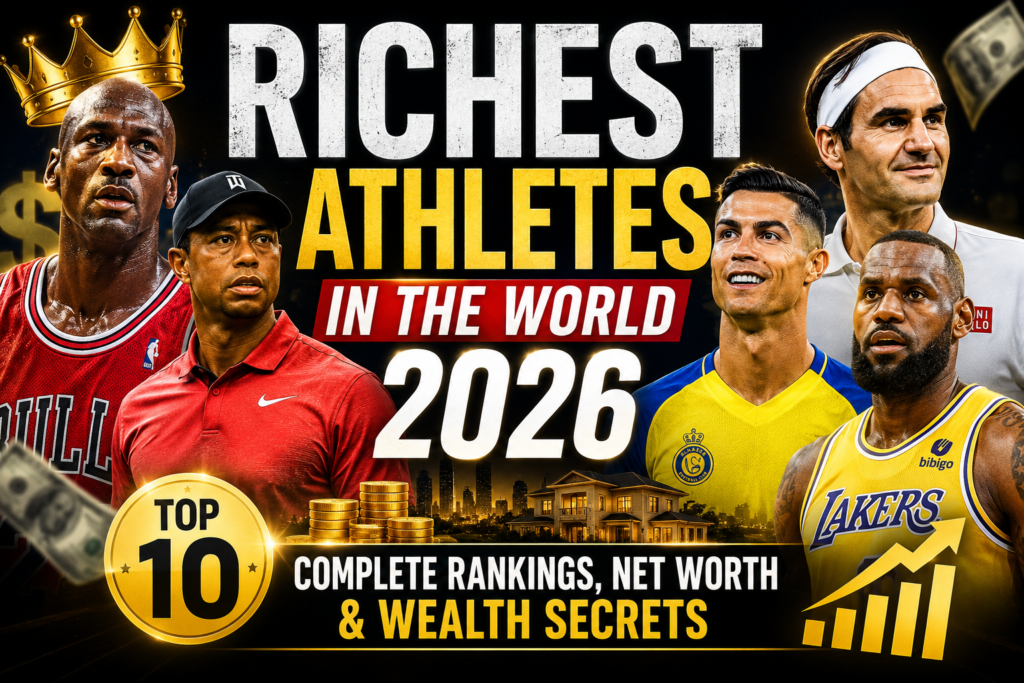
Blog Overview
What you’ll discover in this guide:
- The definitive top 10 richest athletes in the world ranked by net worth (not just annual salary)
- Why Michael Jordan’s $3.5B+ fortune dwarfs every active player on earth — and how he did it
- The three wealth-building mechanisms that separate billionaire athletes from merely rich ones
- Which sports consistently produce the most financial firepower, and why the answer may surprise you
- How Cristiano Ronaldo became the highest-paid active athlete three years running with $260M+ annually
- The critical difference between high earners and true wealth accumulators — and what it means for long-term financial security
- Key data points drawn from Forbes, Sportico, and industry analysts
Table of Contents
- Introduction: Beyond the Paycheck
- Ranking Methodology
- Top 10 Richest Athletes in the World
- Athlete Wealth Comparison Table
- Highest Paid vs. Richest Athletes: A Critical Distinction
- Sports That Create Billionaires
- How Athletes Build Generational Wealth
- Endorsement & Business Venture Breakdown
- FAQs: Richest Athletes in the World
- Conclusion
- SEO & Technical Metadata
Introduction: Beyond the Paycheck
The richest athletes in the world are not just people who play sports well. They are brand architects, venture capitalists, franchise owners, and global icons who happen to have built their platforms on a playing field.
Understanding who the wealthiest sports players really are — and how they got there — requires looking past the contract headlines. A quarterback’s $250 million deal makes news for a week. A stake in a sports franchise compounds quietly for decades.
This guide ranks the top 10 richest athletes in the world by verified net worth, not just annual salary. It then goes further: breaking down exactly how each billionaire or near-billionaire built their fortune, which business moves separated the generationally wealthy from those who simply earned big, and what patterns emerge across sport, era, and geography.
Whether you’re a sports fan, a finance enthusiast, or someone genuinely curious about what it takes to turn athletic talent into a $1 billion-plus empire — there’s a concrete answer here, backed by data from Forbes, Sportico, and decades of documented sports business history.
Ranking Methodology
How we rank the richest athletes in the world: Net worth figures are sourced primarily from Forbes and Sportico — the two most rigorous trackers of athlete financial standing. Net worth reflects total assets (salary history, endorsement income, business equity, real estate, investments) minus liabilities, as best estimated through public filings, known deal structures, and industry reporting.
This list is explicitly not a ranking of annual earnings. Annual salary rankings change year-to-year based on contract structure and single-year payouts. Net worth is the more meaningful measure of lasting financial impact — which is what separates the truly wealthy athlete from one who simply earned a large check in a given season.
Key distinctions applied in this ranking:
- Retired vs. active status is noted but does not disqualify — retired athletes like Michael Jordan continue accumulating wealth at a rate that outpaces most active players
- Business income is included where verifiable (brand royalties, equity stakes, media deals)
- Currency and year — all figures are USD equivalents as of the most recent published data (2024–2025 reporting cycle)
Top 10 Richest Athletes in the World
1. Michael Jordan — Net Worth: ~$3.5 Billion
Sport: Basketball | Status: Retired | Primary Wealth Drivers: Nike/Jordan Brand royalties, former NBA franchise ownership
Michael Jordan is the richest athlete in the world by a margin that isn’t close. His $3.5 billion-plus net worth dwarfs the next wealthiest sports figure by more than $2 billion — a gap that reflects not just extraordinary playing ability, but one of the greatest brand partnership decisions in business history.
When Jordan signed with Nike as a rookie in 1984, the deal was considered a long shot. Nike was a relatively modest company; Jordan was an unproven rookie. The Air Jordan line that emerged from that partnership now generates over $7 billion in annual revenue — a franchise within a franchise that makes Jordan hundreds of millions per year in royalties without him ever lacing up again.
Jordan also owned the Charlotte Hornets NBA franchise, which he purchased in 2010 and sold in 2023 for approximately $3 billion — a transaction that locked in generational wealth from a single sports business deal. His career on-court earnings were around $90 million. His fortune today is built almost entirely on the business decisions made after the final whistle.
Key wealth milestones:
- Air Jordan brand: $7.3B+ in annual revenue (2025), Jordan earns royalties
- Sold Charlotte Hornets stake (~$3B transaction in 2023)
- On-court career earnings: ~$90 million (less than 3% of current net worth)
2. Tiger Woods — Net Worth: ~$1.4 Billion
Sport: Golf | Status: Semi-retired/limited play | Primary Wealth Drivers: Nike partnership (ended 2024), TaylorMade, TGR Ventures, course design
Tiger Woods became the first active athlete to reach billionaire status, per Forbes. The milestone was notable not just for the number, but for how it was reached: less than 10% of Woods’ net worth comes from prize money earned on the course. The remainder flows from decades of elite brand partnerships, course design fees through TGR Design, and equity in ventures including his stake in PopStroke, a luxury mini-golf concept.
Woods earned an estimated $700 million from his Nike partnership alone over the course of their relationship — a deal signed in 1996 for $40 million over five years that grew into one of the most lucrative athlete sponsorships in history. His TGR brand umbrella also encompasses an event company (TGR Live) and a venture arm (TGR Ventures), giving him a diversified business portfolio that generates income well beyond any golf round.
Key wealth milestones:
- Forbes net worth: $1.4 billion (2024–2025)
- Nike career earnings estimated at ~$700 million
- TGR Design, TGR Live, TGR Ventures — active revenue streams post-PGA
- Declined a reported nine-figure LIV Golf offer, preserving long-term brand integrity
3. LeBron James — Net Worth: ~$1.2–1.3 Billion
Sport: Basketball | Status: Active (LA Lakers) | Primary Wealth Drivers: Nike lifetime deal, SpringHill Entertainment, Fenway Sports Group stake, Beats by Dre exit
LeBron James became the first active NBA player to reach billionaire status. His financial story is the clearest modern case study in athlete wealth-building beyond the court: he has earned more off the court than on it every single year since entering the league in 2003.
His lifetime deal with Nike — reportedly worth over $1 billion total — is a cornerstone, but it’s one piece of a broader portfolio. James co-founded SpringHill Company (media and production), holds a minority stake in Fenway Sports Group (parent of the Boston Red Sox and Liverpool FC), and was an early investor in Beats Electronics, cashing out when Apple acquired Beats for $3 billion in 2014 — netting him around $30 million from that single transaction.
Key wealth milestones:
- Nike lifetime deal: $1B+ total value, $30M+ annually
- Fenway Sports Group stake (Boston Red Sox, Liverpool FC)
- SpringHill Company (media/entertainment)
- Beats by Dre investment: ~$30M return on Apple acquisition
- Career NBA salary: ~$480 million (2003–present)
4. Cristiano Ronaldo — Net Worth: ~$1 Billion+
Sport: Soccer/Football | Status: Active (Al Nassr, Saudi Pro League) | Primary Wealth Drivers: Al Nassr contract ($200M/yr), Nike, CR7 brand, social media
Cristiano Ronaldo is the highest-paid active athlete in the world — a title he has held for three consecutive years, per both Forbes and Sportico. His 2025 earnings are estimated at $260–275 million, combining his $200 million Al Nassr salary with approximately $60 million in off-field income.
Ronaldo’s financial power is amplified by something no endorsement deal can fully replicate: he is the most-followed person on social media on earth, with over 1 billion followers across platforms as of 2024. That reach makes every brand partnership exponentially more valuable. His own CR7 brand spans clothing, fragrance, hotels (Pestana CR7), and fitness products — creating a consumer empire that operates independently of any football contract.
Career earnings have crossed the $1 billion threshold, cementing him among history’s highest-earning athletes alongside Lionel Messi.
Key wealth milestones:
- Al Nassr salary: ~$200 million annually
- Nike endorsement: multi-decade partnership, $30M+ per year
- 1 billion+ social media followers — the most of any person on earth
- CR7 Hotels (Pestana CR7), CR7 fragrance, clothing lines
5. Lionel Messi — Net Worth: ~$600 Million
Sport: Soccer/Football | Status: Active (Inter Miami, MLS) | Primary Wealth Drivers: Inter Miami contract ($100M/yr), Adidas, MLS equity stake
Lionel Messi’s journey from Barcelona superstar to MLS player came with a financial structure that goes beyond his $100 million annual Inter Miami salary. His deal reportedly includes equity in the Inter Miami franchise itself, as well as a revenue-sharing arrangement with Apple TV+ and Adidas — creating income streams tied to the growth of American soccer more broadly.
Messi’s net worth sits around $600 million, making him the second wealthiest active footballer. His Adidas partnership, running for decades, earns him an estimated $20–25 million annually and includes signature product lines across boots and lifestyle apparel. With over 500 million Instagram followers, his social influence drives endorsement valuations that go well beyond any logo placement.
6. Roger Federer — Net Worth: ~$1 Billion+
Sport: Tennis | Status: Retired (2022) | Primary Wealth Drivers: On Running stake (~3%), Rolex, Uniqlo
Roger Federer made Forbes’ 2026 celebrity billionaires list, confirming a net worth above $1 billion for the 20-time Grand Slam champion. The Swiss tennis icon’s most financially consequential move came off the court: his estimated 3% equity stake in On Running (the Swiss athletic footwear brand) grew dramatically as the company reached a ~$13 billion market cap on the US stock exchange.
Federer’s long-running deals with Rolex and Uniqlo — including a reported $300 million deal with Uniqlo signed in 2018 — established him as one of sport’s most commercially durable figures. Even two-plus years into retirement, his endorsement value holds.
7. Floyd Mayweather Jr. — Net Worth: ~$450–500 Million
Sport: Boxing | Status: Retired/exhibition bouts | Primary Wealth Drivers: Mayweather Promotions, Showtime PPV deals, Mayweather Boxing + Fitness gyms
Floyd Mayweather built wealth through control — specifically, control over his own promotional and broadcasting deals. His 50-0 professional record was the backdrop, but the $600+ million he earned across landmark fights against Manny Pacquiao ($250M), Canelo Alvarez, and others was structured through his own Mayweather Promotions company, meaning he captured a share of the promoter’s cut most fighters never see.
Net worth estimates vary between $450 million and $500 million, with some discrepancy due to his famously high-spending lifestyle. His Mayweather Boxing + Fitness gym franchise has expanded to over 1,500 locations globally, creating a residual business income stream that operates independent of his ring career.
8. Magic Johnson — Net Worth: ~$1.2 Billion
Sport: Basketball | Status: Retired | Primary Wealth Drivers: Starbucks franchise partnership, cinema development, LA Dodgers co-ownership
Magic Johnson is the clearest example in sports of wealth built entirely in retirement. His playing career with the Los Angeles Lakers earned him comparatively modest sums by modern standards. His fortune — now estimated at $1.2 billion — was built through shrewd franchise business deals, particularly his Starbucks urban licensing partnership in the 1990s and later his involvement in the 2012 purchase of the LA Dodgers for $2.15 billion (a group investment that yielded massive returns).
9. Stephen Curry — Net Worth: ~$500 Million
Sport: Basketball | Status: Active (Golden State Warriors) | Primary Wealth Drivers: NBA salary ($59.6M, top NBA salary for 9 straight years), Under Armour, Eat. Learn. Play. Foundation, Curry Brand
Stephen Curry has commanded the highest NBA playing salary for nine consecutive years — a contractual achievement that speaks to his sustained market value. Beyond his on-court compensation, his Curry Brand partnership with Under Armour generates significant endorsement income, and he has made investments in media and sports franchises.
10. Canelo Alvarez — Net Worth: ~$400–500 Million
Sport: Boxing | Status: Active | Primary Wealth Drivers: Riyadh Season four-fight deal (~$325M total), DAZN, Golden Boy Promotions
Canelo Álvarez represents boxing’s next financial superstar. His February 2025 four-fight deal with Turki Alalshikh — reported by insiders to Sportico to be in the neighborhood of $325 million — elevated his financial standing dramatically. Combined with existing media deals, he is among the highest-earning active athletes in any contact sport.
Athlete Wealth Comparison
Top 10 Richest Athletes: Net Worth at a Glance
| Rank | Athlete | Sport | Status | Est. Net Worth |
| 1 | Michael Jordan | Basketball | Retired | ~$3.5 Billion |
| 2 | Magic Johnson | Basketball | Retired | ~$1.2 Billion |
| 3 | Tiger Woods | Golf | Semi-retired | ~$1.4 Billion |
| 4 | LeBron James | Basketball | Active | ~$1.2–1.3 Billion |
| 5 | Roger Federer | Tennis | Retired | ~$1 Billion+ |
| 6 | Cristiano Ronaldo | Soccer | Active | ~$1 Billion+ |
| 7 | Lionel Messi | Soccer | Active | ~$600 Million |
| 8 | Floyd Mayweather | Boxing | Retired | ~$450–500 Million |
| 9 | Stephen Curry | Basketball | Active | ~$500 Million |
| 10 | Canelo Álvarez | Boxing | Active | ~$400–500 Million |
Sources: Forbes, Sportico, Bloomberg, industry reporting (2024–2025 cycle)
Annual Earnings vs Lifetime Net Worth: The Gap That Defines Wealth
| Athlete | 2025 Annual Earnings | Estimated Net Worth | Net Worth / Annual Ratio |
| Cristiano Ronaldo | $260–275 Million | ~$1 Billion | ~4× |
| LeBron James | $121–133 Million | ~$1.2 Billion | ~9× |
| Michael Jordan | ~$275 Million (royalties) | ~$3.5 Billion | ~13× |
| Tiger Woods | ~$50–60 Million | ~$1.4 Billion | ~25× |
| Magic Johnson | Passive income | ~$1.2 Billion | N/A (retired) |
The ratio column is revealing. Ronaldo earns a staggering sum annually, but his net worth is only 4× his annual income — suggesting relatively concentrated wealth versus diversified long-term accumulation. Jordan’s ratio of 13× reflects decades of compounding business equity. Tiger Woods’ 25× ratio shows the power of invested wealth generating returns that dwarf any single-year paycheck.
Highest Paid vs Richest Athletes: A Critical Distinction The highest paid athletes and the richest athletes in the world are not the same list.
This is one of the most commonly misunderstood aspects of sports wealth.Annual earnings rankings, such as the Forbes or Sportico top-100 lists, measure income over a 12-month period: salary, bonuses, endorsements, appearance fees. They are a snapshot of cash flow. Net worth rankings measure accumulated wealth — the total of everything owned, minus everything owed, built over a career and often beyond it.
The distinction matters because:
Highest earners can be financially fragile. Athletes who earn $100 million per year but spend aggressively, hold no diversified assets, and have no equity positions can end their careers with net worths far below what their paychecks suggested. Numerous documented cases in the NFL, NBA, and boxing demonstrate exactly this.
The richest athletes often earn less annually than the highest paid. Magic Johnson earns no playing salary. Michael Jordan’s court earnings ended in 2003. Tiger Woods barely competed in 2024–2025. Yet all three rank among the wealthiest sports figures alive, because they built asset bases that compound independent of athletic performance.
The key variable is equity vs. income. Income is what you earn. Equity is what you own. The transition from earning to owning — from player to investor, from endorsee to brand holder — is the defining financial move in every billionaire athlete’s story.
Annual Earnings Rankings (2025): Sportico / Forbes Top 10
| Rank | Athlete | Sport | Estimated 2025 Earnings |
| 1 | Cristiano Ronaldo | Soccer | $260–275 Million |
| 2 | Stephen Curry | Basketball | $156 Million |
| 3 | LeBron James | Basketball | $121–133 Million |
| 4 | Lionel Messi | Soccer | ~$135 Million |
| 5 | Jon Rahm | Golf (LIV) | ~$130 Million |
| 6 | Tyson Fury | Boxing | ~$110 Million |
| 7 | Canelo Álvarez | Boxing | ~$100–110 Million |
| 8 | Novak Djokovic | Tennis | ~$40–50 Million |
| 9 | Kevin Durant | Basketball | $101 Million |
| 10 | Patrick Mahomes | Football (NFL) | ~$80–90 Million |
Sports That Create Billionaires
Which sport makes athletes the richest? When measured by the number of athletes who have crossed the $1 billion net worth threshold, basketball stands alone. Golf is second. Soccer and boxing follow.
Why Basketball Produces the Most Billionaire Athletes
Basketball has several structural advantages for wealth building:
- Long careers with high salaries: Elite NBA players routinely earn $40–60 million per year across 15–20 year careers, creating large base capital for investment
- Global brand platforms: Basketball’s worldwide popularity makes athletes like Jordan, James, and Kobe Bryant internationally marketable from day one
- League infrastructure: The NBA’s revenue-sharing model and media rights create franchise values that allow athlete-investors (like Magic Johnson) to profit enormously
NBA billionaires or near-billionaires: Michael Jordan ($3.5B), LeBron James ($1.2B+), Magic Johnson ($1.2B), Shaquille O’Neal (~$400M)
Golf: The Quiet Wealth Machine
Golf may not dominate sports headlines, but it quietly generates enormous long-term wealth:
- Prize money: Top golfers earn 8–9 figure career prize pools
- Corporate appeal: Golf demographics (affluent, globally distributed) make golfers uniquely attractive to luxury brands like Rolex and LVMH
- LIV Golf disruption: Saudi PIF funding through LIV has artificially elevated earnings for top players, with deals like Jon Rahm’s reported ~$280 million annual arrangement elevating career earnings dramatically
Golf’s wealthy names: Tiger Woods ($1.4B), Arnold Palmer (estate), Jack Nicklaus (course design and licensing), Roger Federer (On Running equity)
Soccer: Volume, Not Density
Soccer produces the highest-earning athletes annually (Ronaldo, Messi, Neymar), but the fewest billionaires relative to earnings — partly because the sport’s earning peak years are short, player representation structures leave less room for equity deals, and career financial planning has historically lagged behind NBA or golf counterparts.
The Saudi Pro League’s arrival has changed annual earnings dramatically, but sustainable wealth-building through business ownership remains less common among soccer stars than in basketball.
Boxing: High Ceiling, High Risk
Boxing creates extraordinary single-event paydays — Mayweather vs. Pacquiao remains the richest fight in history at over $600 million in total revenue. But the sport’s financial model is concentrated in a few peak earning years, without the steady salary floor of team sports or the endorsement durability of golf. Athletes who control their own promotional rights (Mayweather) prosper. Those who don’t often leave enormous sums on the table.
Sport Billionaire Comparison
| Sport | Billionaire Athletes | Notes |
| Basketball (NBA) | 3+ (Jordan, LeBron, Magic Johnson) | Most consistent pathway |
| Golf | 2+ (Woods, Federer adjacent) | Long endorsement careers |
| Tennis | 1+ (Federer) | Brand longevity key |
| Soccer/Football | 1+ (Ronaldo, approaching Messi) | Saudi money reshaping picture |
| Boxing | 0 confirmed | Mayweather closest at ~$450-500M |
How Athletes Build Generational Wealth
The mechanics of athlete wealth creation are well-documented but rarely explained in full. Six distinct mechanisms account for virtually every major sports fortune:
1. Playing Salary: The Foundation, Not the Fortune
Playing salary is what most people associate with athlete wealth — and it’s the least important factor in building lasting financial standing. LeBron James earned approximately $480 million in NBA salary across a 22-year career. His net worth exceeds $1.2 billion. The salary didn’t build the gap; the investments did.
That said, salary matters as capital. Without a large income base to invest and deploy, the other mechanisms don’t activate. The athletes who build the most wealth are those who treat salary as seed capital for the real strategy — not as the destination.
2. Endorsements: The Leverage Engine
Brand partnerships can generate income that exceeds playing salary by multiples. Key dynamics:
- Duration: Long-term deals compound value. Federer’s Rolex deal, Ronaldo’s Nike partnership, Jordan’s Air Jordan arrangement — all span decades
- Equity terms: Modern endorsement deals sometimes include equity stakes in the brand. LeBron’s Beats deal, Federer’s On Running stake — these created returns that cash-payment sponsorships never could
- Social media multiplier: Every million followers represents measurable brand value. Ronaldo’s 1 billion+ social following directly influences the dollar value his partners receive and therefore what they pay him
3. Business Ownership: Where Wealth Compounds
Owning equity in businesses — rather than simply endorsing them — is the transition that separates the wealthy from the exceptionally wealthy:
- Michael Jordan: Air Jordan royalties, Charlotte Hornets (sold)
- LeBron James: SpringHill Company, Fenway Sports Group minority stake, Blaze Pizza ownership stake
- Magic Johnson: Starbucks franchise empire, Dodgers co-ownership
- Tiger Woods: TGR Design, TGR Live, PopStroke stake
4. Sports Franchise Investment
Owning stakes in sports franchises is increasingly the preferred vehicle for athletes with serious capital. The NFL, NBA, and Premier League franchises have appreciated dramatically over the past 20 years — often outperforming traditional equity markets.
LeBron James’ stake in Fenway Sports Group gives him exposure to the Boston Red Sox, Liverpool FC, and Pittsburgh Penguins. His investment, made through RedBird Capital in 2021, has likely appreciated significantly as FSG assets have grown. Magic Johnson’s Dodgers involvement returned enormous sums when the team’s valuation skyrocketed post-purchase.
5. Real Estate and Alternative Investments
High-net-worth athletes routinely deploy capital into real estate, especially in gateway cities where appreciation has historically been strong. Ronaldo owns multiple Pestana CR7 hotel properties. Messi has real estate holdings across Argentina and Spain. LeBron owns properties in LA, Akron, and Miami.
Beyond real estate, athletes are increasingly active in venture capital, crypto, and private equity — though these carry substantially higher risk than franchise investment or brand equity positions.
6. Media, IP, and Content
The media rights attached to an athlete’s name and story represent a growing asset class. LeBron James’ SpringHill Company has produced content for Netflix, Amazon, and NBC. Ronaldo’s personal documentary deals and social media IP generate income streams that function like a media business. Post-career, athletes who own their narrative and IP retain value that purely athletic achievements cannot.
Endorsement & Business Venture Breakdown
Major Endorsement Partnerships
| Athlete | Primary Brand Partner | Est. Annual Value | Notable Terms |
| Cristiano Ronaldo | Nike | $30M+ | Lifetime deal |
| LeBron James | Nike | $30M+ | Lifetime deal (1B+ total) |
| Tiger Woods | TaylorMade | Undisclosed | Post-Nike (2024 onward) |
| Lionel Messi | Adidas | $20–25M | Decades-long partnership |
| Roger Federer | On Running | Equity stake | ~3% in $13B company |
| Stephen Curry | Under Armour | Curry Brand | Signature line |
| Michael Jordan | Nike/Jordan Brand | Hundreds of millions (royalties) | Most lucrative in sports history |
Business Ventures & Equity Holdings
| Athlete | Business Venture | Category | Status |
| Michael Jordan | Jordan Brand (Nike subsidiary) | Apparel/Royalties | Active — $7.3B/yr revenue |
| LeBron James | SpringHill Company | Media/Entertainment | Active |
| LeBron James | Fenway Sports Group stake | Sports Franchise | Active |
| LeBron James | Blaze Pizza | Franchise | Active |
| Magic Johnson | Starbucks franchise network | F&B | Sold/Divested |
| Magic Johnson | LA Dodgers co-ownership | Sports Franchise | Sold |
| Tiger Woods | TGR Design / TGR Live | Course Design/Events | Active |
| Tiger Woods | PopStroke stake | Entertainment/Golf | Active |
| Cristiano Ronaldo | CR7 Hotels (Pestana CR7) | Hospitality | Active |
| Roger Federer | On Running equity | Athletic Apparel | Active |
FAQs:
Who is the richest athlete in the world?
Michael Jordan is the richest athlete in the world, with a net worth estimated at approximately $3.5 billion as of 2025. His wealth comes primarily from royalties generated by the Jordan Brand (a Nike subsidiary) and his former ownership stake in the Charlotte Hornets, rather than his NBA playing salary, which totaled around $90 million — less than 3% of his current net worth.
Which athletes are billionaires?
As of 2025, confirmed billionaire athletes include Michael Jordan (~$3.5B), Tiger Woods (~$1.4B), LeBron James (~$1.2–1.3B), Magic Johnson (~$1.2B), Roger Federer (~$1B+), and Cristiano Ronaldo (~$1B+). Lionel Messi and Floyd Mayweather are considered near-billionaires in the $450–600 million range.
Who is the highest paid active athlete in the world?
Cristiano Ronaldo is the highest-paid active athlete in the world, earning an estimated $260–275 million in 2025, according to both Forbes and Sportico. This includes approximately $200 million from his Al Nassr contract and $60+ million from endorsements including Nike, Herbalife, Binance, and his CR7 brand.
What is the difference between highest paid and richest athletes?
Highest paid refers to annual income — salary, endorsements, and bonuses earned in a single year. Richest refers to net worth — total accumulated assets minus liabilities, built over an entire career. An athlete can be the highest-paid in the world in a given year and still have a lower net worth than a retired player who invested wisely decades ago. Michael Jordan has earned no playing salary since 2003 but remains the wealthiest athlete alive.
How do athletes become billionaires?
Athletes reach billionaire status through one or more of the following: (1) extraordinarily durable endorsement deals that generate income for decades (Jordan/Nike, Woods/Nike, Federer/On Running); (2) equity ownership in sports franchises whose valuations have increased dramatically (Jordan with the Hornets, James with FSG, Magic with the Dodgers); (3) building consumer brands under their own name (CR7, Jordan Brand, LeBron’s SpringHill); (4) early-stage investments in companies that later reached large-scale exits (James/Beats, Federer/On Running IPO). Salary alone has never made an athlete a billionaire.
Which sport creates the most billionaire athletes?
Basketball has produced more billionaire athletes than any other sport, with Michael Jordan, LeBron James, and Magic Johnson all crossing the $1 billion threshold. Golf is second, with Tiger Woods joining the list in 2022. The combination of long NBA careers, global brand appeal, and increasing athlete involvement in franchise ownership makes basketball the most reliable sport for building long-term wealth at the elite level.
What is Cristiano Ronaldo’s net worth in 2025?
Cristiano Ronaldo’s net worth in 2025 is estimated at approximately $1 billion or above, with career earnings having crossed the $1 billion threshold. His annual earnings of $260–275 million make him the world’s highest-paid active athlete, though his net worth remains below that of retired athletes like Jordan and Tiger Woods due to the different wealth-accumulation structures of their respective careers.
Can athletes lose their wealth after retiring?
Yes — and historically many have. Studies cited by Sports Illustrated and others estimate a significant percentage of professional athletes face financial difficulty within a few years of retirement. The primary reasons: spending that outpaced diversified investment, lack of equity ownership during peak earning years, poor financial management, and over-reliance on a single income stream (playing salary). The athletes who maintain and grow wealth after retiring share a common trait: they converted income into equity during their careers, not after.
Conclusion
The richest athletes in the world share more with successful founders and investors than they do with their peers who simply earned the highest paychecks. The defining variable isn’t how much they made at their peak — it’s what they did with the platform their sport gave them.
Michael Jordan’s $3.5 billion fortune is a case study in brand equity. Tiger Woods’ $1.4 billion is a lesson in endorsement longevity and business diversification. LeBron James’ ongoing accumulation — active player, $1.2 billion and climbing — reflects deliberate, decades-long financial architecture that treats athletic fame as a launchpad, not a destination.
For anyone tracking athlete wealth — whether as a fan, investor, or simply someone curious about the mechanics of extraordinary financial success — the key takeaway is this: the highest-paid athletes and the richest athletes are not the same people. The highest earners show up in annual rankings. The truly wealthy show up in Forbes’ billionaire list, often long after their playing days ended.
The gap between those two outcomes is entirely a function of what happens between the paychecks.
Visit Markestra